Best Video Game Genres for Beginners: How to Choose Your First Game
2026年4月10日
Ever watched someone play video games and been amazed by their clean triple kill? Ever told yourself you’d finally get into video games, only to feel overwhelmed by the countless genres and platforms?
This guide aims to help you out!
In the following sections, we’ll first go over the basics of video games, then discuss the eight most popular genres in 2026 (ranked from beginner-friendly to advanced), and provide some tips for choosing a game.
After reading, you’ll have a clearer picture of where to start and how to choose the right game!
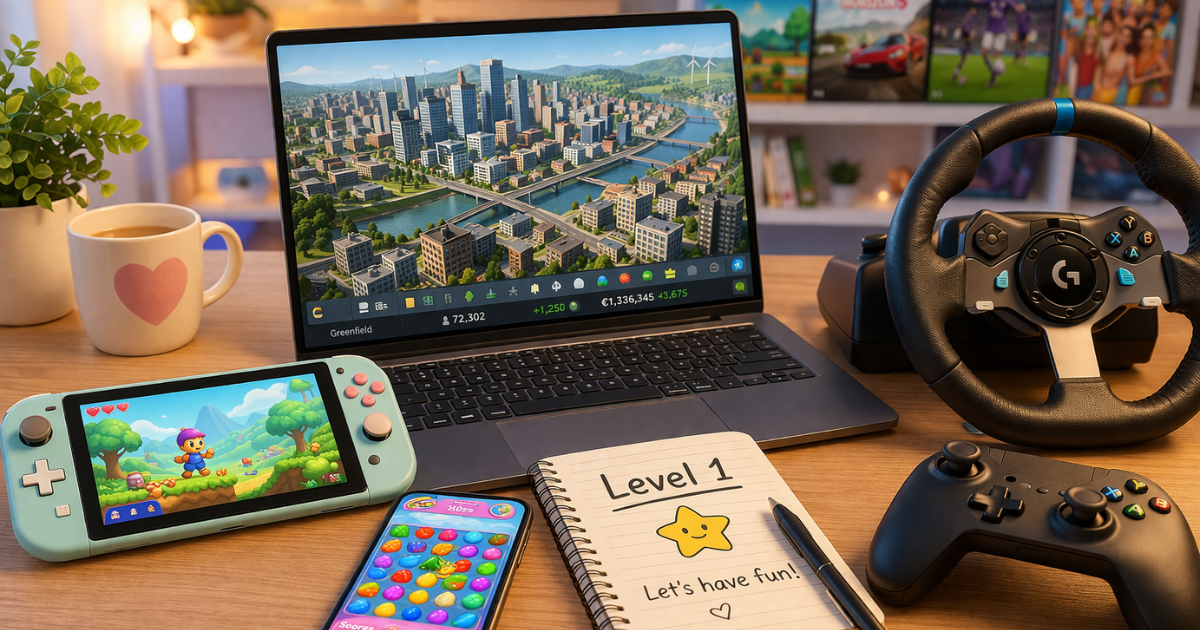
What are Video Game Genres?
Video game genres are a way of grouping games based on what the player actually does in the game.
For instance, action games feature fast-paced combat and skill execution, while strategy games highlight decision-making and long-term planning.
Notably, many genres overlap. This is because game developers want to offer players diverse experiences within a single game. Hence, it is not uncommon to see games like action titles with RPG elements or adventure games with survival mechanics.
Why Genre Matters When You’re New
If you are new to video games, it’s quite common to be fascinated by players who play smoothly, or by the names of a few extremely popular games. However, there are many different types of games to choose from, and different people may enjoy vastly different genres depending on their personality and life experiences.
To help break out of this “echo chamber” and reduce information asymmetry, we aim to cover the most common game genres, so you can better understand what to expect and choose games that truly match your preferences.
8 Most Popular Video Game Genres Ranked by Difficulty in 2026
In the following sections, we’ll go through the 8 most popular video game genres in 2026, ranked from beginner-friendly to more advanced ones.
The difficulty ratings are based on both community discussions (such as Reddit) and our own judgment, so treat them as a general reference.
In each section, we’ll cover the key features of each genre, its common subtypes, main challenges, accessibility, and price range. We’ll also include example games, along with a trailer for a representative game.
Puzzle Games(🌟)
Puzzle games focus on problem-solving. They offer a slower, more focused experience, where players gain satisfaction from finding the correct solution through logic and reasoning.
Interestingly, while some games are purely puzzle-based (e.g., Minesweeper), many integrate puzzle elements into other genres, such as adventure games.
Common types: logic puzzles, physics-based puzzles, and match-based puzzles
Main challenges: logical reasoning and pattern recognition
Accessibility: high (easy to pick up, no prior experience needed)
Price range: free to low (many are free or low-cost)
Examples: Minesweeper (logic puzzles), Portal (physics-based puzzles), Candy Crush Saga (match-based puzzles)
Sports & Racing Games (🌟🌟)
Sports and racing games simulate real-world competitive activities, such as football and car racing. They can either closely replicate real sports experiences or offer a more arcade-style approach to increase accessibility.
Meanwhile, some of them also emphasize strategy, such as Football Manager.
Common types: simulation sports, arcade sports, racing games, sports management
Main challenges: timing, control, and in some cases, strategy and decision-making
Accessibility: medium (easy to pick up, but harder to master)
Price range: mid to high (mostly paid games)
Examples: FIFA (football simulation), Forza Horizon 5 (racing), Football Manager (sports management)
Simulation Games(🌟🌟)
Simulation games replicate real-world systems or activities, allowing players to create their own dream worlds based on their ideas. Freedom, immersion, and player-driven goals are key characteristics of this genre.
To be more specific, some simulation games aim for realism (e.g., flight simulators), while others focus on open-ended gameplay, often overlapping with sandbox elements.
Common types: life simulation, vehicle simulation, city-building / management simulation
Main challenges: planning, resource management, and long-term decision-making
Accessibility: medium (easy to start, but systems can become complex over time)
Price range: mid (mostly paid titles with large-scale systems)
Examples: Cities: Skylines II (city-building), Microsoft Flight Simulator 2024 (vehicle simulation), inZOI (life simulation)
Action Games(🌟🌟🌟)
Action games are known for their fast-paced gameplay. Players are expected to rely on quick reflexes, combat skills, and smart decision-making to perform well. They are one of the most popular genres due to their intensity.
While some action games prioritize pure combat and mechanics, others blend in story and exploration, often overlapping with adventure or RPG elements.
Common types: shooters, platformers, fighting games, hack-and-slash
Main challenges: reaction speed, timing, and combat execution
Accessibility: medium to high (easy to start, but skill-based to master)
Price range: free to mid (ranging from free-to-play shooters to premium titles)
Examples: Call of Duty (shooter), Prince of Persia: The Lost Crown (platformers), Tides of Annihilation (hack-and-slash), Street Fighter (fighting)
Adventure Games(🌟🌟🌟)
Adventure games require exploration and puzzle-solving, usually set against a story-driven backdrop. Players progress by discovering and exploring uncharted places, uncovering the story and its mysteries.
Many games blend adventure elements with action or RPG systems.
Common types: point-and-click adventures, action-adventure, and visual novel
Main challenges: exploration, puzzle-solving, and decision-making
Accessibility: medium (easy to understand, but may require patience and exploration)
Price range: mid (mostly paid titles with story-driven content)
Examples: Centum (point-and-click adventures), Eternal Strands (action-adventure), The Walking Dead (visual novel)
RPG Games (🌟🌟🌟🌟)
RPGs focus on character progression. They often function like a coming-of-age experience, allowing players to control a character who becomes stronger through various challenges in an immersive world.
While traditional RPGs are more story-driven and structured, many modern games combine RPG elements with action gameplay or multiplayer features.
Common types: action RPG (ARPG), Japanese RPG (JRPG), MMORPG, tactical RPG (TRPG)
Main challenges: character building, resource management, and long-term decision-making
Accessibility: medium to low (requires time investment and understanding of systems)
Price range: mid to high (mostly premium titles with large content scope)
Examples: Crimson Desert (ARPG), Final Fantasy VII Rebirth (JRPG), World of Warcraft (MMORPG)
Sandbox Games(🌟🌟🌟🌟🌟)
Sandbox games give players a high degree of freedom. Instead of following a fixed storyline, players are allowed to set their own goals however they like.
To some extent, they are similar to simulation games, which emphasize real-world modeling and systems. As a result, a mix of simulation and sandbox elements is quite common.
However, sandbox games can also combine survival, crafting, or RPG elements.
Common types: open-world sandbox, survival crafting
Main challenges: self-direction, resource management, and long-term engagement
Accessibility: medium (easy to start, but can feel overwhelming due to open-ended design)
Price range: mid (mostly premium titles with large, content-rich worlds)
Examples: Abiotic Factor (survival crafting), Enshrouded (open-world sandbox)
Strategy Games(🌟🌟🌟🌟🌟)
Strategy games call for players to have a top-down or “omniscient” perspective. To achieve victory, players need to plan in advance, manage resources wisely, and adapt their tactics flexibly. It’s like building a world from zero to everything.
Common types: real-time strategy (RTS), turn-based strategy (TBS), grand strategy
Main challenges: planning, resource management, and tactical decision-making
Accessibility: medium to low (requires learning systems and strategic thinking)
Price range: mid to high (mostly premium titles with deep systems)
Examples: Age of Empires IV (RTS), Civilization VII (TBS), Stellaris (grand strategy)
Quick Comparison of Game Genres
Genre | Difficulty | Price Range | Core Experience | Hardware Needed |
Puzzle | ⭐ | Free → Low | Logic solving, pattern recognition, relaxed thinking | Low (mobile/low-end PC is enough) |
Sports & Racing | ⭐⭐ | Mid → High | Timing, control, competition, fast-paced matches | Medium (console or mid-range PC recommended) |
Simulation | ⭐⭐ | Mid | System management, creativity, and real-world emulation | Medium to High (depends on complexity, PC recommended) |
Action | ⭐⭐ | Free → Mid | Reflex-based combat, fast-paced gameplay, skill execution | Medium (smooth performance recommended, console or PC) |
Adventure | ⭐⭐⭐ | Mid | Exploration, storytelling, puzzle-solving | Low to Medium (most devices supported) |
RPG | ⭐⭐⭐⭐ | Mid → High | Character progression, story immersion, long-term growth | Medium (long playtime, stable performance preferred) |
Sandbox | ⭐⭐⭐⭐⭐ | Mid | Freedom, exploration, player-driven goals | Medium to High (large worlds may require better hardware) |
Strategy | ⭐⭐⭐⭐⭐ | Mid → High | Planning, resource management, tactical decision-making | Low to Medium (high-end PC helps for complex simulations) |
Suggestions for Choosing Video Games for Beginners
- Start with Simple Controls: Many beginners struggle with 3D movement and camera controls. Start with games that have fun concepts and are easy to pick up.
- Watch Gameplay Videos: If you're unsure about a game, watch some gameplay videos to see if it matches your interests.
- Don’t be afraid to explore: Your preferences may change over time. Once you feel comfortable, try different genres to discover new experiences and expand your interests.
- What If Like Multiple Genres?
As we mentioned at the beginning of this guide, many games actually offer multiple types of experiences and can fall into more than one genre at the same time. So it’s completely normal if you find yourself enjoying multiple genres.
Here are a few classic examples of games with overlapping genres for reference:
- inZOI: Simulation × Sandbox
- Cities: Skylines II/ Stellaris: Simulation × Strategy
- Forza Horizon 5: Simulation × Sports
- Final Fantasy VII Rebirth: Action × RPG
- The Witcher 3: Wild Hunt: Action × RPG × Adventure
Make Your Own Video Game Assets by Using Triverse AI
After exploring these different game genres, you might be wondering: “Could I create something like this myself?”
The answer is yes. Game development isn’t just for professionals. It values curiosity, creativity, and a willingness to explore. Understanding game genres is already your first step.
Whether you’re part of a large team or an indie developer, tools like Triverse make the process much easier by using AI to generate 3D assets. Simply describe what you need, and a 3D model can be generated in minutes. You can then import it directly into engines like Unity or Godot.
Conclusion
Getting into video games doesn’t have to be complicated. With so many video game genres available, just start with the one that matches your interests or attracts you for any reason.
While we’ve introduced eight major genres and ranked them from easy to more challenging, there’s no single “best” choice, only what works best for you.
As you explore more, you’ll naturally discover what you enjoy and build your own preferences. And if you ever feel inspired to take it a step further, we also offer tutorials to help you create your own 3D assets in Triverse AI.
FAQs about Video Game Genres
How many video game genres are there?
There’s no fixed number of video game genres. Many modern games also combine multiple genres, which makes the total number flexible rather than strictly defined.
What is the most popular video game of all time?
It depends on how you measure popularity. Games like Minecraft and Grand Theft Auto V are among the best-selling of all time. Meanwhile, games like Fortnite and Call of Duty remain popular due to their large active player bases.
What are the big 3 in gaming?
The “big 3” usually refers to the major console platforms: Sony (PlayStation), Microsoft (Xbox), and Nintendo. These companies dominate the console market and shape many trends in gaming through their exclusive titles, hardware, and online ecosystems.
What is the easiest video game genre for beginners?
Puzzle games and casual simulation games are often the easiest to start with. They usually have simple controls, slower pacing, and minimal pressure. These genres help beginners get comfortable with basic mechanics before moving on to more complex or fast-paced games.
Can I play games without a gaming PC?
Absolutely. Many games are available on consoles, mobile devices, or even through cloud gaming services. You don’t need a high-end PC to start playing. There are plenty of beginner-friendly options across different platforms.
What’s the best genre for playing with friends?
Multiplayer-friendly genres like action, sports, and sandbox games are great for playing with friends. These games often include cooperative or competitive modes, allowing you to team up or compete in real time for a more social experience.
Do I need a controller to play games?
Not necessarily. Many games can be played with a keyboard and mouse, especially on PC. However, controllers can provide a more comfortable experience for certain genres like racing, sports, or platformers. It depends on the game and your personal preference.
How long does it take to learn a new game genre?
It varies depending on the genre. Simple genres like puzzle games can be learned within minutes, while more complex ones like strategy or RPG may take several hours or even days to fully understand. Practice and patience are key.
Are violent games harder than non-violent ones?
Not necessarily. Difficulty depends more on gameplay mechanics than content. Some violent games can be easy to play, while non-violent ones, like strategy games, can be very challenging. It’s better to judge difficulty based on systems and complexity rather than theme.