Best Backrooms Games to Play in 2026
2026年5月6日
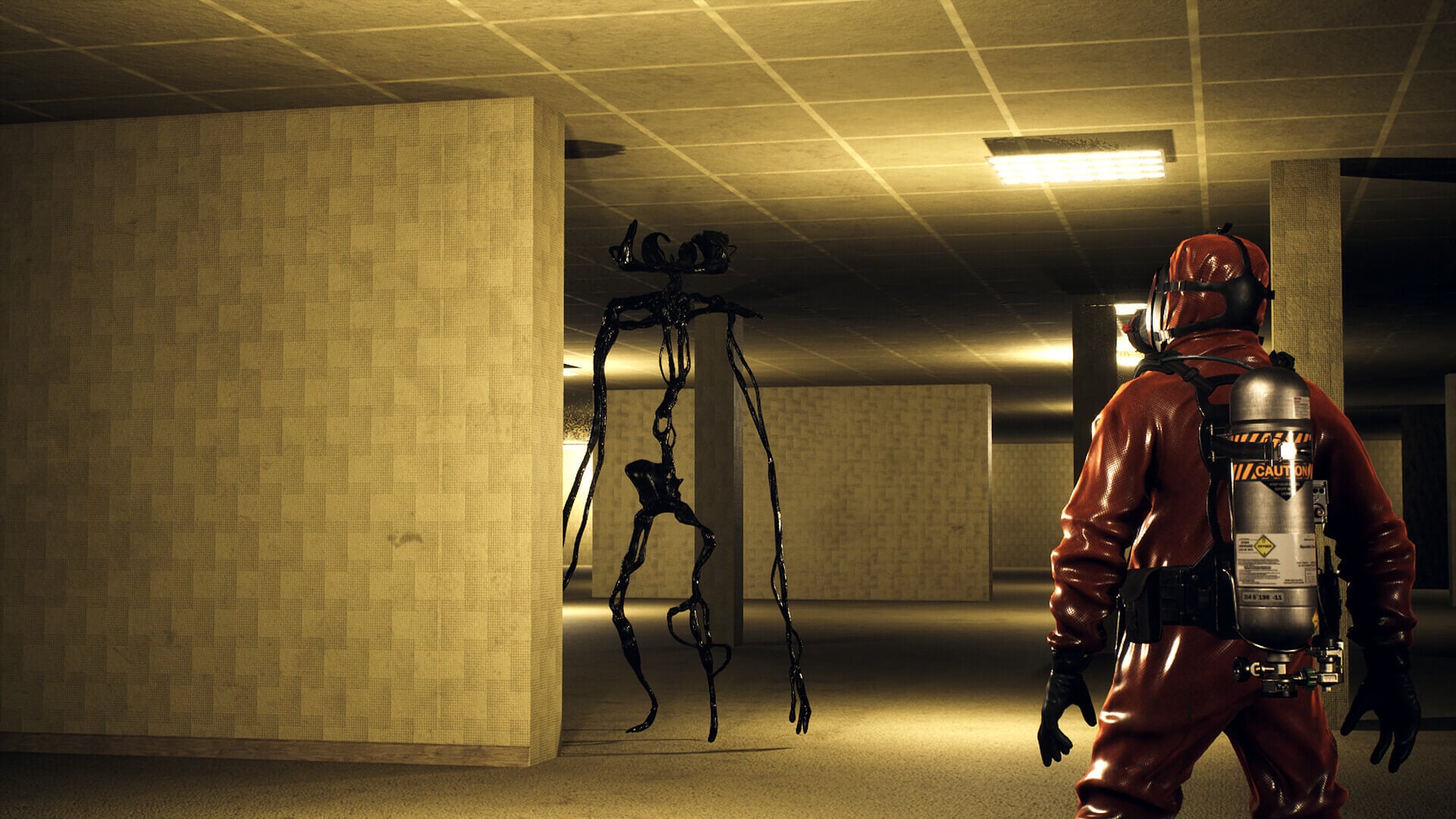
The Backrooms started as a 2019 4chan post describing an accidental "noclip" out of reality into an infinite maze of yellow-walled office space. No enemies. No objectives. Just buzzing fluorescent lights and the certainty that something is watching. It shouldn't have become a genre. But it did.

By 2026, the Backrooms had spawned dozens of games across every platform, a feature film from A24, and two active wiki communities collectively documenting over 900 levels. Some are genuinely terrifying. Others are forgettable. This guide separates the best from the rest.
What Makes a Great Backrooms Game?
Before the rankings, understand what separates the good from the forgettable. We evaluated every game on three criteria:
- Atmosphere: Does the space feel genuinely unsettling, or just yellow?
- Entity design: Are the monsters memorable, or generic horror tropes?
- Replayability: Is there a reason to come back, or is it a one-and-done experience?
The best Backrooms games share a handful of design principles. Understanding these helps you evaluate any game you come across.
Atmosphere Over Aesthetics
The original Backrooms concept required just five textures: yellow wallpaper, office carpet, fluorescent ceiling panels, baseboard trim, and door frames. That's it. Yet it terrified millions.
The lesson is simple: horror scales with atmosphere, not budget. The fluorescent hum, the silence between sounds, the geometry that doesn't quite add up; these create dread without a single jump scare.
The worst Backrooms games load up on monsters and gore. The best ones understand that the space itself is the monster.
Entity Design: Sound-Based Threat
Traditional horror games show you the enemy. Backroom games are different.
The most effective Backrooms entities hunt by sound, not sight. In co-op versions with proximity voice chat, this creates a unique mechanic: whispering saves you, but talking gets you killed.
The Smiler, a face embedded in walls that only appears when you look directly at it, is the iconic example. Some games go further, creating entities that you hear but never fully see, which is far more unsettling.
For developers building Backrooms games, this means audio detection logic matters more than pathfinding AI. You need:
- Sound radius generated by player movement
- Entity detection based on audio, not visibility
- Quiet movement as a survival mechanic
Procedural Generation Without Complexity
Backroom games don't need hundreds of hand-crafted rooms. The design principle: 3-5 base room geometries, random connections, texture, and lighting variants applied through seeds.
This creates the illusion of infinite space while keeping production scope manageable for indie developers. The key is structured randomness; connections should feel plausible, not completely arbitrary.
The Best Backrooms Games Ranked
1. Inside the Backrooms (Best Overall)
Platform: Steam | Price: ~$10 | Players: 1-4 co-op
Inside the Backrooms takes the top spot because it understands what makes the Backrooms concept work: other people make it worse.
The co-op multiplayer with proximity voice chat transforms the experience. In a single-player Backrooms game, silence is safety. In Inside the Backrooms, silence among your friends becomes its own source of tension. Who among you is going to speak first? Who noticed that sound three corridors away?
The entity AI uses audio triangulation rather than visual detection. Sprinting to escape danger is exactly the wrong move; you're advertising your position. This turns every decision into a risk calculation: move fast and loud, or slow and quiet.
Atmosphere is the standout. The procedural level generation creates genuinely unpredictable spaces. The yellow office aesthetic is elevated by dynamic lighting that shifts from bright fluorescents to complete darkness depending on the sector. The sound design, constant electrical hum, distant echoes, sudden silence; it ranks among the best in the genre.
What to know before buying: The game is still in active development. Some sectors feel less polished than others. Multiplayer requires coordination; playing with strangers can be chaotic in both fun and frustrating ways.
Best for: Players who want the most complete Backrooms experience, especially with friends.
2. The Backrooms 1998 ( Best Found Footage Experience)
Platform: Steam | Price: ~$8 | Players: Solo
If Inside the Backrooms is the multiplayer reference, The Backrooms 1998 is the single-player benchmark. Its found-footage presentation, camera grain, limited FOV, no HUD, creates intimacy that third-person games cannot match.
You're not controlling an avatar. You're holding a camera in a place you shouldn't be.
The entity design leans into the Smiler archetype but adds environmental variants: entities that appear only on camera, shadows that move independently of objects, and rooms that shift when you're not looking directly at them. The VHS-style visual treatment makes everything feel like recovered footage from 1998, which it claims to be.
The level design is hand-crafted rather than procedural, which means every room has purpose and intentional horror beats. The pacing is slow and deliberate — this isn't a game that rushes you through scares. It builds dread over time.
What to know before buying: The found-footage style isn't for everyone. Movement feels constrained by the camera mechanic. Some players find the slow pacing frustrating; others find it deeply immersive.
Best for: Players who prefer solo horror with strong atmosphere over co-op mechanics.
3. Backrooms: What's Next (Best Story Integration)
Platform: Steam | Price: ~$12 | Players: Solo
Backrooms: What's Next prioritizes narrative over mechanics. Where other games treat the Backrooms as a setting for survival horror, this one treats it as a world to explore and understand.
The story follows a documentation team investigating the Backrooms as a phenomenon rather than escaping it. This framing, you're a scientist, not a victim, changes how you engage with the space. You're not running from rooms; you're cataloging them.
The level variety is the game's strongest asset. While other Backrooms games stick to the classic yellow office aesthetic, Backrooms: What's Next spans dozens of documented wiki levels: concrete bunkers, flooded tunnels, endless warehouses, and levels that break spatial logic entirely.
Entity encounters are more narrative than mechanical. The game invests in explaining what the entities are, not just that they're dangerous. For lore hunters, this is the most satisfying Backrooms game available.
What to know before buying: The story's focus means less survival tension. If you're looking for pure scare, other games deliver more consistently. If you want to understand the Backrooms world, this is it.
Best for: Lore-focused players who want Backrooms content that respects the mythology.
4. Backrooms Game (backroomsgame.io) — Best Free Browser Option
Platform: Browser | Price: Free | Players: Solo
No list is complete without the accessible entry point. backroomsgame.io delivers a minimal but effective Backrooms experience directly in your browser; no download, no purchase, no commitment.
What it lacks in production value, it makes up for in purity. The concept is stripped to its essentials: first-person navigation through procedurally generated yellow rooms, minimal UI, no hand-holding. You spawn, you walk, you find doors, you keep walking.
The horror comes from exactly what made the original concept terrifying: the realization that there's no goal, no end, no escape; just more rooms. The fluorescent hum plays continuously. The silence when you stop is profound.
It's the Backrooms as a concept, unmediated by game design decisions.
What to know before buying: It's free, which means limitations. No entity encounters, no objectives, no progression. Some players find this liberating; others find it hollow. If you want to understand the Backrooms concept before investing in a full game, start here.
Best for: First-timers, accessibility-conscious players, or anyone who wants to experience the core concept before committing to a full game.
5. Fancy's Escape the Backrooms — Best Mobile Experience
Platform: Mobile (iOS/Android) | Price: Free with ads | Players: Solo
For mobile players, Escape the Backrooms by Fancy is the most complete Backrooms experience on a handheld device. Touch controls are well-optimized; movement is smooth, camera control is responsive, and the UI doesn't clutter the screen.
The game features multiple levels drawn from the Backrooms wiki, entity encounters with basic but effective AI, and a progression system that unlocks new sectors as you complete objectives. The free-to-play model includes ads, but they're not intrusive during gameplay.
The atmosphere is surprisingly strong for a mobile game. The fluorescent lighting, the yellow walls, the ambient audio; it all translates effectively to earbuds. Mobile gaming's intimate screen size actually enhances the claustrophobic feeling.
What to know before buying: Mobile free-to-play means monetization pressure. In-app purchases exist but aren't required to progress. Graphics are limited by mobile hardware; don't expect Steam-level visuals.
Best for: Mobile players who want a substantive Backrooms experience on the go.
Quick Comparison
Game | Platform | Price | Best For |
Inside the Backrooms | Steam | ~$10 | Best overall, co-op |
The Backrooms 1998 | Steam | ~$8 | Solo found-footage horror |
Backrooms: What's Next | Steam | ~$12 | Story and lore |
backroomsgame.io | Browser | Free | Quick access, concept demo |
Escape the Backrooms | Mobile | Free | Mobile play |
The Design Secrets Behind the Best Backrooms Games
The games on this list work because their developers understood something fundamental: the Backrooms isn't about monsters. It's about space, sound, and the absence of control.
If you've played these games and wondered why they work — or if you're a developer building your own Backrooms experience — here's what separates the effective from the forgettable.
Sound Carries More Fear Than Visuals
In the best Backrooms games, sound does 70% of the work. The constant electrical hum of fluorescent lights, the distant sounds that seem to follow you, the sudden silence when the hum cuts out; these create baseline anxiety that no monster design can match.
The implementation is simpler than you'd expect:
- A 60Hz electrical hum on loop with random volume fluctuation (±3dB every 5-15 seconds)
- Spatial reverb that makes empty rooms sound vast
- Distance attenuation so sounds behave according to the space geometry
- Silence as a reward, and as a warning
When the hum stops, players know something changed. Use this sparingly for maximum impact.
Five Textures and Infinite Rooms
The Backrooms concept was born from constraint. Five textures, yellow wallpaper, office carpet, fluorescent panels, trim, doors, and basic geometry. That's the entire asset budget for the original concept.
The horror comes from repetition. The same yellow wall in 50 consecutive rooms creates psychological pressure. Your brain recognizes the pattern and starts anticipating a threat. When something breaks the pattern, a door that's slightly open, a room that's too dark, a sound that doesn't belong, the contrast amplifies the fear response.
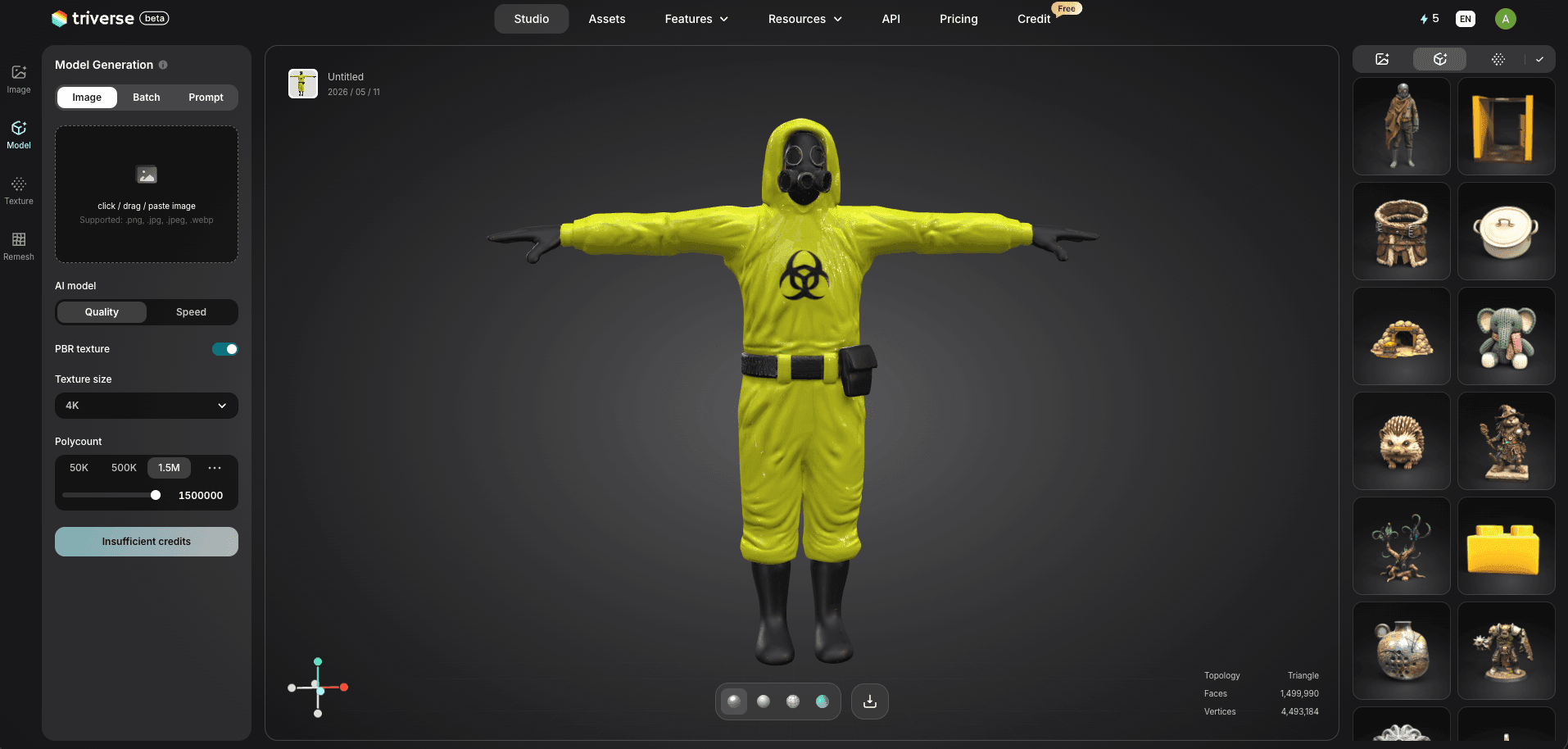
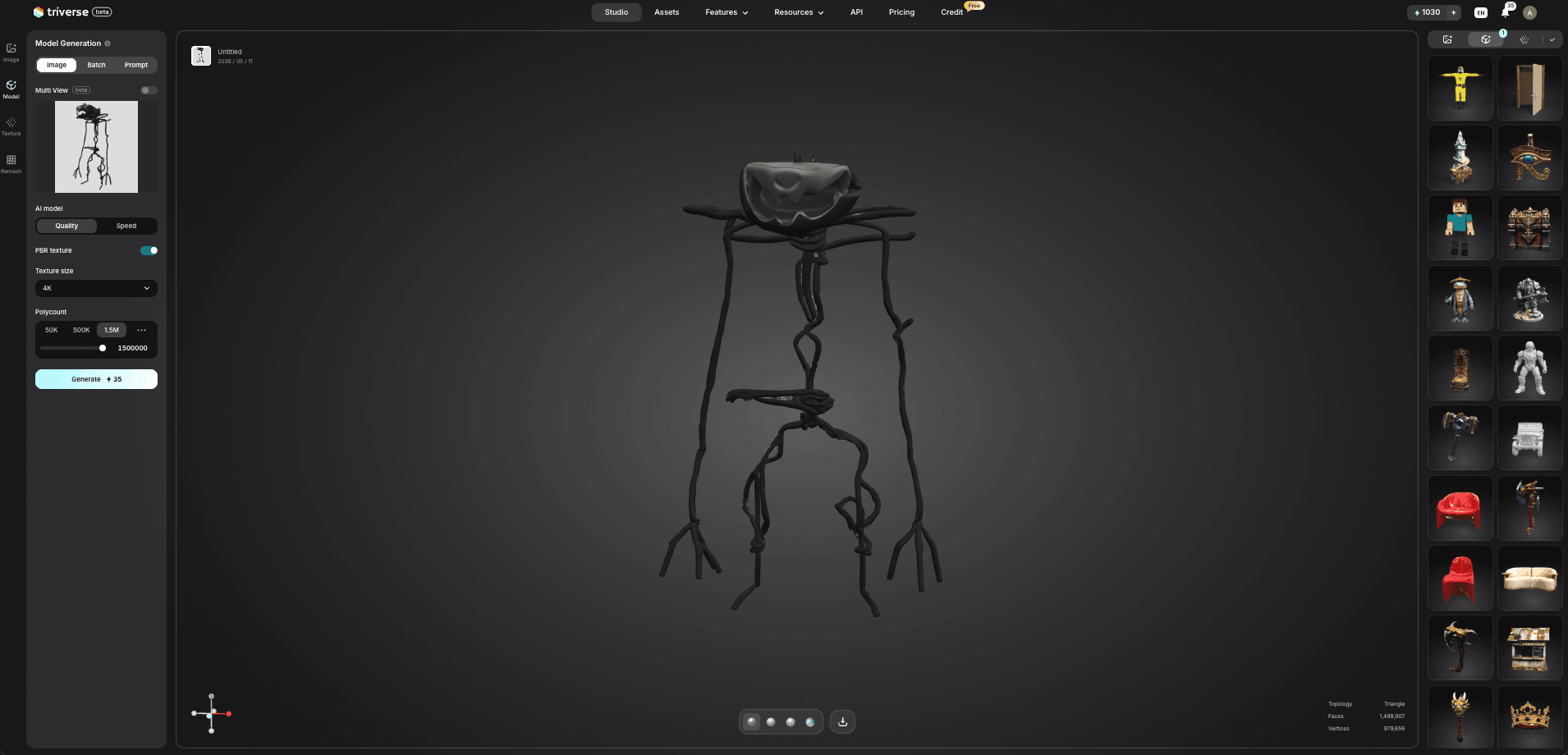
For indie developers prototyping Backrooms games, AI-assisted tools like Triverse AI can generate room geometry and environmental pieces in minutes.
Quick workflow:
- Describe your room: Prompt example: "narrow yellow office corridor with fluorescent ceiling lights, worn carpet, water-stained walls, one slightly open door at the end".
- Generate and export: Triverse produces a .GLB/.FBX/.OBJ/.3MF/.STL/.USDZ file with UV mapping already applied.
- Import to engine: Drag into Unity or Unreal; materials connect automatically.
- Add your systems: Audio detection, entity AI, procedural connections.
Compare that to modeling each corridor by hand. The time saved goes into the systems that make players afraid to stay quiet.
If you're looking to create 3D models for game environments, the same principles apply: generate variations on your core five textures, apply procedural texturing, and build the connection logic on top.
Entity AI That Listens
The most effective Backrooms entities don't chase you. They listen.
Audio detection logic is technically simple but mechanically deep:
- Player movement generates a sound radius
- Entities have an audio detection range (not visual)
- Quiet movement reduces detection probability
- Sprinting in dangerous areas attracts attention
You don't need complex pathfinding. You need audio triangulation. For game developers building similar AI systems, understanding how AI tools generate 3D models for game characters translates directly to entity behavior logic. A player who understands audio-based survival can survive longer by moving carefully. A player who doesn't will learn the hard way.
This mechanic is why proximity voice chat in co-op Backrooms games is so effective. The real human fear of accidentally alerting your friends to your location creates tension that no scripted encounter can match.
Autophobia and Vitophobia as Design Tools
The best Backrooms games exploit two specific fears:
Autophobia — the fear of being alone — is addressed through environmental design. Distant sounds that seem to follow you. Doors that close on their own. Long empty corridors where silence itself feels threatening. The goal is to make players feel watched even when nothing is visible.
Vitophobia — the fear of glass — comes into play at levels with transparent barriers. You can see the entity, but you're not sure if it can see you. The asymmetry creates tension without combat. Glass walls that are slightly dirty, slightly opaque, slightly unreliable — these are more effective than explicit monster encounters.
How to Build Your Own Backrooms Game
Ready to create your own Backrooms experience? Here's the implementation roadmap that the best games on this list follow.
Step 1: Define Your Constraint Set
Start with 3-5 asset types maximum. Yellow walls, carpet, lights, trim, and doors. Define your color palette. Establish your audio baseline. The constraint isn't limiting; it is the aesthetic.
Step 2: Build the Procedural Core
- Create 3-5 room geometries (square, L-shape, corridor, large hall, T-junction). Define structured connection rules: each room has 1-3 exits, not random. Apply texture and lighting variants through seeds, not hand-placement. Unity's NavMesh system handles pathfinding for these procedural connections efficiently.
Step 3: Implement Audio Detection
Your entity AI needs:
- Audio detection radius around the player
- Detection probability based on movement speed
- Behavior responses: investigate (move toward last sound), patrol (set route), hunt (actively search)
Step 4: Design for Atmosphere, Not Scares
Resist the urge to add jump scares. The best Backrooms moments are quiet ones: a door that wasn't there before, a hum that cuts out, a room that feels slightly wrong. Build the atmosphere first. Let the scares emerge from the system. Unreal Engine's Audio Analyzer provides the spatial audio tools needed for these effects.
Step 5: Seed Community Content
The Backrooms wikis grew into a universe because the original concept defined constraints, not content. If you're building a Backrooms game, document your core mythology publicly and invite contribution. The community will expand your world faster than you can alone. For broader game asset workflows, see our guide on free STL files for 3D printing and tree supports in 3D printing for environmental asset techniques.
Frequently Asked Questions about Backrooms Game
What is the Backrooms game based on?
The concept originated from a 2019 4chan /x/ thread where a user described accidentally "noclipping" out of reality into an infinite office space. It evolved through YouTube content (particularly Kane Pixels' viral short films) into multiple playable games and a broader collaborative fiction universe.
How many Backrooms levels exist?
The Backrooms wikis collectively document over 900 levels, but playable games typically implement 10-20. The design principle is depth over quantity; each level should feel purposeful rather than procedurally generated filler.
Are Backrooms games actually scary?
The best ones are. It depends on the implementation. Games that rely on jump scares feel hollow; games that build atmosphere through sound, lighting, and spatial design create genuine dread. Inside the Backrooms and The Backrooms 1998 are the most consistently effective at building real tension.
What's the scariest Backrooms game?
Inside the Backrooms for multiplayer tension. The Backrooms 1998 for solo atmospheric horror. Both use audio-based threat systems rather than visual jump scares; this creates sustained dread rather than momentary shock.
Is the Backrooms game appropriate for younger players?
Most Backrooms games carry horror content warnings. The themes, isolation, being hunted, and liminal spaces, are mature. Recommended for teen players and up, depending on individual sensitivity to horror content.
What's the difference between the Wikidot and Fandom Backrooms wikis?
Both document the Backrooms mythology, but with different communities and additions. The Backrooms Wikidot documents the mythology with a clinical, documentation-style tone. The Fandom wiki includes more creative interpretations and fan fiction. Both are worth exploring if you're interested in the lore.
Will there be a Backrooms movie?
A24 is developing a feature film adaptation. No release date has been confirmed as of 2026, but the production was announced following the success of the Backrooms as a gaming and internet culture phenomenon.
What engine are Backrooms games built on?
Most indie Backrooms games use Unity for its accessibility and strong audio tools. Unreal Engine appears in games that prioritize visual rendering quality. For solo developers, Unity is the practical choice; for teams prioritizing visuals, Unreal offers better rendering capabilities at higher complexity.
Final Thoughts
The Backrooms became a genre because it proved something: fear doesn't need a budget. It needs an understanding of why certain spaces make humans uneasy.
The games on this list work because their developers understood that the space itself is the monster. The fluorescent hum. The yellow walls that never end. The silence feels deliberate. These are the ingredients.
Whether you're looking for a co-op session with friends, a solo found-footage experience, or a browser quick-scare, the Backrooms has something. Start with backroomsgame.io if you're new. Graduate to Inside the Backrooms for the complete experience. And if you want to understand why these games work — that's the more interesting question, and the one worth exploring.
Building your own Backrooms game? Try Triverse AI to generate room geometry and environmental assets in minutes: describe your aesthetic, generate the base, and focus your energy on the sound design that makes players afraid to make noise.