Can GPT-6 Astra Replace AI 3D Generators?
GPT-6 Astra writes Blender scripts and builds meshes. But can it replace AI 3D generators? Dive into this developer benchmark comparison with real numbers.
September 23, 2026
OpenAI announced GPT-6 Astra on September 3, 2026, and within hours the demos flooded in: a kart racing game built from a prompt, a house modeled in Blender and exported to Unreal Engine 5, a spaceship rendered from a text description. Tech blogs declared it the end of dedicated 3D tools. After spending two weeks running Astra through real game asset workflows, here is the unfiltered answer for developers and artists who need reliable, engine-ready output, not demo clips. The short version: Astra is a serious tool, but it is not a 3D generator. Understanding the difference saves you hours of cleanup and rework.
What GPT-6 Astra Actually Does in 3D (and Where It Gets That From)
GPT-6 Astra is not a 3D model generator in the way dedicated AI 3D tools are. It does not run a diffusion model trained on mesh distributions. Instead, it combines three abilities that happen to be useful for 3D work.
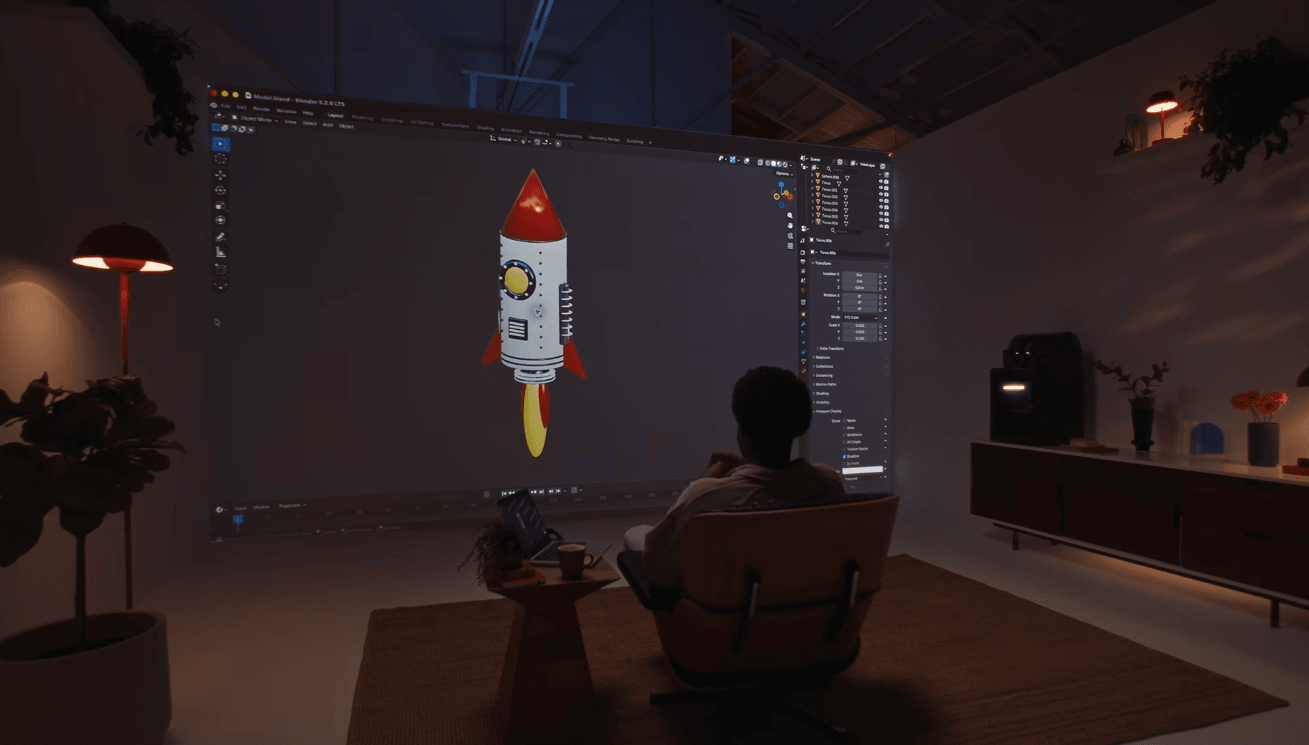
First, computer use. GPT-6 Astra can open Blender, click through menus, read the viewport screenshot, and decide what to do next. It operates software the way a human would, just faster and without getting bored.
Second, coding. GPT-6 Astra writes Blender Python scripts and CAD generation code. Give it a description of a building, and it can produce a script that generates walls, windows, and a roof as parametric geometry.
Third, spatial reasoning. OpenAI measured this with BenchCAD, a benchmark that tests whether a model can reconstruct a 3D object from multi-view renders by writing CAD code rather than generating a mesh directly. According to reporting from VoxelMatters, GPT-6 Astra scored 95.9% on the benchmark's mean voxel IoU metric. That measures how closely the reconstructed geometry overlaps with the original object. The previous GPT-5.6 Sol scored 83.3%. Anthropic's Claude Fable 5.1 scored 84.3%. OpenAI also reported that Astra reached this score at roughly 43% lower estimated API cost than Sol and 86% lower than Fable 5.1 in the configurations tested.
None of these three abilities are fundamentally new. Models like Opus 4.5 and Fable could already write Blender scripts and reason about spatial layouts. GPT-6 Astra is a stronger version of the same approach, and that matters. But it also means Astra inherits the same ceiling: it is working through code and GUI manipulation, not through a model trained to produce geometry directly.
The Two-Capability Framework That Explains Everything
If you read one section of this article, read this one. The confusion around "can GPT-6 Astra replace 3D tools" comes from mixing up two fundamentally different AI capabilities.
Capability 1: Understanding. Large language models and vision-language models read images, infer what objects are present, reason about spatial relationships, and plan sequences of steps. This is what GPT-6 Astra does. It can look at a photo of a chair and tell you the legs are cylindrical, the seat is roughly 40 cm wide, and the back leans 10 degrees. It can then write code to reproduce that chair.
Capability 2: Generation. Diffusion and flow models trained on 3D mesh data produce geometry by learning the distribution of shapes directly. You feed in an image or a text prompt, and the model outputs a mesh. It does not write code. It does not operate Blender. It generates geometry the way Stable Diffusion generates pixels.
These are separate training objectives. A model can be world-class at understanding and mediocre at generation, or vice versa. This is why the academic community has not reached consensus on whether generation helps understanding, even though understanding clearly helps generation. The practical result in industry is that most pipelines use an LLM or VLM for prompt expansion and planning, then hand off to a diffusion-based generator for the actual mesh creation.
Think of it this way: knowing exactly how a portrait is constructed, down to the brushstroke angles and pigment ratios, does not make you a portrait painter. GPT-6 Astra knows how 3D geometry works. Dedicated generators paint it.
Why the Panic Hit 3D First
When GPT-6 Astra's demos went viral, image and video generation companies barely reacted. That reaction gap is worth reading.
Start with timing. Image and video generation already absorbed this exact shift. By the time GPT-6 Astra arrived, those tools had been routing their prompts through language and vision models for months, and several image models were built on vision-language backbones from the start. The 3D generation field sits roughly six to twelve months behind that same curve. A step that felt routine elsewhere feels like a disruption here.
Then look at what low detail means in each medium. In image and video, a low-fidelity frame is a failure. Nobody ships a blurry render or a melted face. In 3D, low detail is often the goal. A game needs a clean 10,000-triangle background prop, not a film-accurate sculpture, and a simple mechanical part does not have to match a reference down to the millimeter. For that class of work, a model that understands geometry and writes code is genuinely competitive.
So the threat is real, but narrower than the headlines suggest. GPT-6 Astra raises the floor for simple 3D tasks. It does not raise the ceiling for fidelity-critical assets. OpenAI's own showcase rocket is a mechanical shape with a straightforward surface and no need to match a specific reference. That is exactly the kind of object the model handles well, and exactly the kind that never tests the hard case.
What GPT-6 Astra Handles Well
Given the framework above, you can predict where GPT-6 Astra shines. It excels at tasks that reduce to rules, parameters, and code.
Parametric and mechanical geometry. Simple shapes described by dimensions are Astra's sweet spot. A box, a cylinder, a bracket with specified hole positions, a building with given floor plans. These objects follow mathematical rules, and GPT-6 Astra can write the code to produce them reliably.
Low-poly modular kit pieces. Game developers often need simple, low-triangle-count pieces for background fills and modular environments. Astra can generate a low-poly barrel, crate, or wall segment via script without much trouble, as long as the detail level stays low.
CAD-style reverse engineering. The BenchCAD benchmark exists precisely because this use case matters. If you have photos of an industrial part and need to reconstruct editable CAD geometry, Astra's 95.9% voxel IoU score means it can get close. This is useful for reverse engineering physical parts where you need parametric geometry you can modify, not a static mesh.
Scene assembly and layout. Astra can take a list of objects and place them in Blender at specified coordinates. This is tedious work for a human and well within Astra's coding ability.
Quick concept blockouts. Before detailed modeling begins, you often need a rough spatial layout to test proportions and sightlines. Astra can produce these blockouts from a description in minutes.
Where Astra Still Falls Short
The same framework tells you where Astra struggles. If a task requires generating geometry that matches a specific visual reference with high fidelity, Astra is the wrong tool.
Here is where that boundary sits in practice.
Limitation | Why it happens | What it means for you |
|---|---|---|
Organic character detail | Astra is trained to reason about geometry, not to reproduce visual likeness from reference photos | A character face or organic creature from a reference will look like a person, but not the specific person. Game characters need manual sculpting or a generation model. |
Texture output | Astra sets up PBR material nodes in Blender; it does not bake a UV-unwrapped texture set in a single pass | You get a material setup, not a finished texture. A diffusion generator gives you both geometry and embedded PBR textures as one output. |
Time and cost | Astra completes a task by writing, executing, and reviewing code, then iterating; every revision burns more tokens at LLM rates ($10/M input, $50/M output) | A single asset takes roughly 2.5 to 6 minutes and can reach tens of dollars. A diffusion generator does the same task in 60 to 90 seconds at a flat per-generation credit cost. |
Non-manifold geometry | Astra writes code, and code logic can produce open edges, duplicate vertices, or inverted normals | Game engines need watertight geometry. If your AI 3D generation output needs cleanup, cleanup for Astra meshes is more involved than for diffusion output because the errors are logical, not statistical. |
For organic character detail specifically, the gap is visible when you push on it. Ask an agent to build an armed and armored character. It understands the overall form, but rendering convincing facial anatomy, armor relief, and fabric folds through code alone means iterating on surface approximation with every pass. A generation model produces those organic forms directly. The agent then handles the assembly questions: are the proportions consistent, how should the sword connect to the hand, which models need polygon reduction?
The Decision Matrix: Which Tool for Which Task
Here is the practical table. "GPT-6 Astra Alone" means Astra can finish the task without help from a generation model. "Only via API" means Astra cannot generate the asset itself, but it can call a dedicated generator's API as part of a script.
Task | Astra Alone | Use a Dedicated AI 3D Generator |
|---|---|---|
Simple box, bracket, or mechanical part | Yes | Overkill |
Low-poly environment prop (barrel, crate) | Yes | Unless detail is needed |
Architectural model from dimensions | Yes | For complex shapes |
Scene layout and object placement | Yes | N/A |
Character from reference photo | Only via API | Yes |
Detailed game prop with textures | Only via API | Yes |
Organic creature or face | Only via API | Yes |
Batch of diverse textured assets | Only via API | Yes |
The pattern is clear: Astra wins on rule-based geometry, dedicated generators win on anything that requires matching visual detail or producing textures. On the four "Only via API" rows, Astra can still be part of the workflow by calling a generator's API, but the generation itself is done by the dedicated model. If you want to click once and get a textured character or prop, you need a generation tool in the pipeline, whether Astra triggers it or you do. For a deeper look at what separates usable output from demo output, check our guide on what makes a 3D model game-ready.
A Real Workflow: Building a Game Prop Two Ways
To make this concrete, let us build the same asset both ways: a medieval barrel for a fantasy game.
Astra scripting | Dedicated AI generator | |
|---|---|---|
Input | Text description | Reference image |
Time to first mesh | Roughly 2.5 to 6 minutes per revision cycle | Sixty to 90 seconds |
Textures | None. You UV unwrap and apply textures manually | Geometry with embedded PBR textures in one step |
Post-processing | UV unwrap, texture creation or sourcing, material setup | Manifold check, export as GLB |
Time to game-ready | An hour or more, including iteration | Typically under five minutes for a clean reference |
Best for | When you have no reference image and need parametric control | When you have a clear reference image and need a finished prop fast |
Astra scripting means you prompt the model to write a Blender Python script that generates a cylinder, adds hoop details, and creates stave grooves. The code generation and execution loop takes several minutes. The mesh has clean topology but no textures, so you still need to UV unwrap and source or create wood textures.
With a dedicated generator, you upload a reference image of a medieval barrel and the tool produces a textured mesh in about sixty seconds. Export as GLB, run a quick manifold check, and drop it into your engine.
The quality difference tracks the input. With a clear image, the dedicated tool produces a better barrel, faster. Without a reference and only a description, Astra's parametric approach has an edge, but textures still require separate work.
The Blending Possibility: Using Both in One Pipeline
The most interesting workflow in late 2026 is not choosing between Astra and a dedicated generator. It is using both together.
Here is a pipeline that takes advantage of each tool's strength. Astra handles scene structure and simple geometry: it writes scripts to place buildings, generate fences, and lay out terrain features based on a level description. A dedicated generator handles the detailed pieces: you generate 3D props from images or text for characters, detailed furniture, and organic elements. Both outputs come together in Blender.
Astra can also act as a coordinator. Because it can call APIs, it can drive a dedicated generator's API as part of a longer script. Astra reads a scene description, decides which assets to generate, calls the generator's API for each one, and places the results. This is where Astra genuinely adds value to a 3D pipeline. It does not replace the generator. It orchestrates it.
One concrete illustration of this pattern: an agent decomposes a complex mechanical object, delegates the intricate main components to a specialized 3D foundation model, and then handles the structural assembly work itself using procedural code. A hydraulic hose, for instance, is a tubular structure between two points, which is exactly what code does well. The boom, tracks, and body shell are irregular surfaces that a generation model handles better than a script. The agent assembles the whole thing in Three.js. This is the practical shape of the "understanding and generation together" pipeline in 2026, and it goes further than either tool alone.
The efficiency argument matters here. When Astra writes procedural code to approximate complex organic geometry, it spends tokens describing low-level surface details. Every iteration adds more tokens explaining how to make the outline more accurate. Delegating to a generator condenses that entire process into a single API call. The agent can then direct its reasoning budget toward the decisions that actually benefit from it: how to break down the object, which parts to generate separately, how the pieces relate in space, and how to assemble the final result.
The Blender Python API documentation covers the scripting side of this workflow. OpenAI's GPT-6 Astra announcement details the model's computer-use and coding capabilities in full. For the generation side, the Khronos glTF 2.0 specification defines the format that most generators export to and most engines import natively.
Where Triverse AI Fits in This Picture
If you have read this far, you know where this is going. Triverse AI is built for the generation side of the equation.
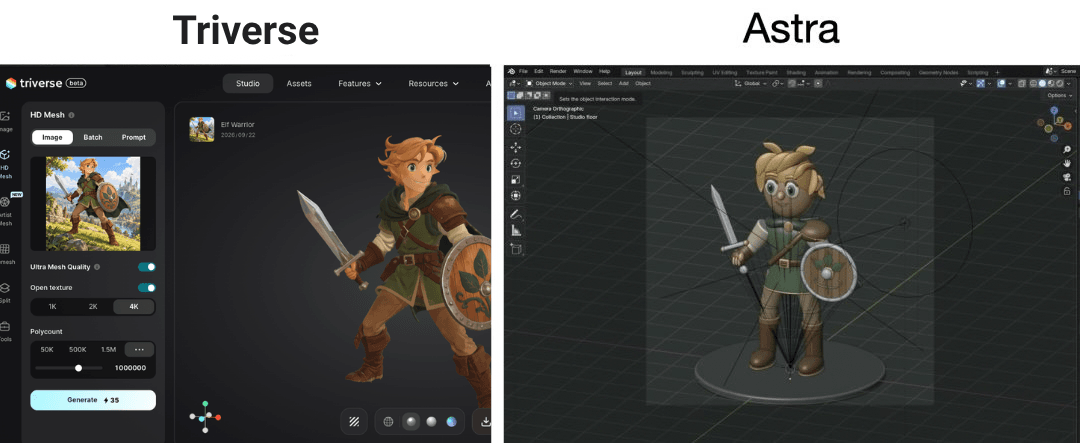
Triverse does not write scripts or operate Blender. It uses diffusion-based models to produce 3D geometry from images and text prompts. The Artist Mesh workflow takes a reference image and outputs a clean triangle mesh in about sixty seconds, with topology that is ready for game engines without retopology. For text-to-3D, the HD Mesh workflow generates high-polygon meshes suitable for baking normal maps or feeding into Nanite.
When to use Triverse instead of Astra: any time you have a reference image and need a game-ready mesh quickly. Triverse handles the quality-critical steps that Astra cannot: producing manifold geometry, generating PBR textures at up to 4K resolution, and exporting in multiple formats including GLB, OBJ, FBX, and STL.
For batch work, Triverse's Batch generation handles multiple images at once, with the Pro plan running up to three generations concurrently. The Unity Model Import settings handle Triverse's GLB exports directly, so the pipeline from generation to engine is short.
One feature worth knowing about for game asset pipelines is Triverse Split. Upload a single image that contains multiple objects, and Split breaks it into individual cards automatically. Each card becomes a separate generation task: you can refine it independently, regenerate without re-uploading the source image, and then bring all the resulting assets into Blender to assemble the full scene. A character concept art piece that includes armor, weapons, and accessories becomes six or more game-ready components rather than one monolithic model. This is closer to how a human artist would approach the same work, and it is exactly the kind of decomposition step that an orchestration agent like Astra needs from a generator.
Bottom Line
GPT-6 Astra is a powerful coding and computer-use agent that can assist with 3D modeling tasks. It is not a 3D generator. The distinction matters because the two types of tools are built on different foundations, and they solve different problems.
For simple, parametric geometry like boxes, brackets, and building layouts, Astra via scripting is viable and cost-effective. For game-ready, detail-critical, or organic assets, dedicated diffusion-based generators produce better results in less time, with textures included.
The best workflow in 2026 uses both. Astra assembles scenes and handles simple geometry. A dedicated generator like Triverse AI handles the detailed, textured, game-ready pieces. If you have a reference image and need a mesh you can drop into an engine today, start with a dedicated generator.
A note on permanence. None of the gaps listed above are permanent. Astra is a newly released model, and the agentic loop gets cheaper and faster as context windows grow and models waste fewer tokens on failed revisions. Baking a full texture set through Blender's own tooling is a plausible near-term addition. What will not change is the training-objective split: a model trained to reason about geometry is not the same model trained to make that geometry look right. The realistic path is Astra calling a generator's API, not Astra becoming one.
One more way to frame it. Model intelligence and model output quality are separate objectives. An LLM is trained to reason well. A 3D generator is trained to produce geometry that looks right. A model can understand a scene completely and still output a mesh you cannot ship, and a generator can produce a polished asset while understanding almost nothing about the object itself. Game work needs both ends of that, which is why the honest answer is not replacement. It is division of labor.
FAQs about GPT-6 Astra and AI 3D Modeling
Can GPT-6 Astra generate 3D models directly?
Astra writes Blender scripts and CAD code rather than producing meshes through a generation model. The geometry comes from executing the code it writes, which means the output depends on code quality and usually needs manual review.
What is the BenchCAD benchmark and why does it matter?
BenchCAD tests whether an AI model can reconstruct editable CAD geometry from multi-view renders by writing code. Astra scored 95.9% mean voxel IoU, compared to 83.3% for GPT-5.6 Sol and 84.3% for Claude Fable 5.1. It measures spatial reasoning, not mesh generation quality.
Is Astra faster than a dedicated AI 3D generator?
For simple parametric geometry via scripting, Astra can be fast. For complex or textured assets, a dedicated diffusion-based tool completes the same task in roughly a minute versus several minutes through the code-and-iterate loop.
Can Astra replace Meshy, Tripo, or other dedicated AI 3D tools?
Not for precision work. Astra and dedicated generators like Meshy and Tripo are built on different foundations. Astra handles rule-based geometry well. Dedicated generators handle detailed, organic, and texture-rich assets that Astra cannot produce reliably.
Does Astra work with Blender?
Yes. Astra's computer-use agent can open Blender, execute Python scripts, read the viewport, and plan the next modeling step. This is useful for automating repetitive tasks and generating simple procedural geometry.
Can I use Astra and a dedicated generator in the same workflow?
Yes. A practical pipeline uses Astra for scene assembly and simple geometry, then feeds reference images to a dedicated generator for detailed pieces. Both outputs combine in Blender. Astra can also call a generator's API as part of a longer automation script.
What is the cost difference between Astra and a dedicated AI 3D tool?
Astra is priced per API token. A dedicated tool like Triverse charges per generation credit. For bulk simple geometry, Astra scripting can be cost-effective. For detailed game-ready assets, per-credit pricing often delivers better value per usable output because you get textures and clean topology in a single step.