Generate 3D Props From Image or Text Prompts: A Practical Workflow
How to generate 3D props from images or text prompts: when to use each input, how to write prop prompts, the generation workflow, and getting props game-ready for Unity and Unreal.
September 1, 2026
You need 40 crates, barrels, and wall lamps in your level by Friday. You do not model them by hand. You generate 3d props from image or text prompts and drop them into the engine. The catch is that a generated prop is a starting point, not a finished asset. Here is the workflow that gets props from a prompt into your scene without a cleanup marathon.
What "Generate 3D Props From Image or Text Prompts" Actually Means
The phrase covers two routes to the same result. You either describe the prop in words and let the AI build it, or you hand it a picture and let the AI reconstruct it. Both end with a 3D mesh you can open, texture, and place. That is what it means to create 3D props with AI, and it is 3D asset generation from prompts at its most practical.
Two Inputs, One Output
Text input is pure description. Image input is a reference the model matches. The output, a textured 3D prop, is the same either way. The difference is how much control you have over the shape before generation starts.
Why Props Are the Best Use Case for AI Generation
Props are repeatable, self-contained, and tolerant of imperfection. A slightly off chair leg is fine in a background crate stack. A slightly off character face is not. That tolerance makes prop work the fastest win in AI 3D prop generation, which is why every major generator leads with props in its examples.
Image or Text: Which One to Use for Your Prop
This is the real question behind the keyword. Image VS. text for 3D props isn't about which tool is better. It is about what you already have.
Use a Text Prompt When You're Ideating
Starting from words is for exploration. You do not have a reference, you want options, and you want to iterate fast. Text to 3D prop generation shines here because you can spin ten variations of "a rusted oil drum" before lunch and pick the one that fits.
Use an Image When You Have the Exact Reference
If you already have concept art, a photo of a real object, or a sprite you must match, image to 3D prop conversion beats description every time. The model reads the silhouette, materials, and details straight from the picture, so the result tracks your reference instead of guessing it. This is also how you get low-poly 3D props from image references that match your art direction.
You Can Mix Both (Text Generates, Image Refines)
Most workflows let you start from text, accept the AI's reference image, then regenerate from that image. That hybrid is the safest path: text gets you close, the image locks the look. It is the standard loop in tools like Tripo, where a prompt first becomes a picture, then the picture becomes the mesh.
How to Decide: Image vs Text for Your Prop
No reference and need ideas: use text. Have concept art or a photo: use image. Want speed and variants: text. Want an exact match to a real object: image. Most production runs start with text and finish with an image pass.
How to Write a Prop Prompt That Doesn't Come Back Generic
Weak prompts return weak props. The fix is structure, not luck. This is how to make 3D props from text that do not look like placeholders.
The Prop Prompt Anatomy (Subject, Material, Style, Details)
Every strong prop prompt has four parts. The subject (what it is), the material (wood, metal, ceramic), the style (low-poly, stylized, realistic PBR), and the details (skull lock, gold trim, cracked paint). Drop any one and the result gets generic.
Prompt Progression: From "A Crate" to a Finished Asset
Sloyd's own example shows the climb. "A treasure chest" gives a brown box. "An ancient wooden treasure chest" adds character. "An ancient wooden treasure chest with a skull lock and gold trim, low-poly style" gives a finished asset. Each step adds one anatomy layer.
Keywords That Signal Game-Ready Output
Add pipeline words to the prompt so the generator biases toward usable output. "Game ready," "game asset," and "clean topology" push toward cleaner meshes. "Low-poly" or "stylized" sets the polygon budget. "One solid piece" tells the model to avoid floating geometry that you would have to weld later.
3D Prop Generation Checklist
Before you generate a batch:
- Pick input: text for ideation, image for exact match
- Write the prompt with subject, material, style, details
- Add "game ready" and a style keyword (low-poly, stylized, PBR)
- Generate 3 to 5 variations; keep the best silhouette
- Add PBR, split movable parts, skip rigging for static props
- Export GLB or FBX, import to engine
- Clean mesh, set real-world scale and base pivot
- Build LODs for background props: most engines support automatic LOD generation, and Triverse's 1K preset is already a natural LOD1 for many props
The 3D Prop Generation Workflow, Step by Step
A repeatable 3D prop generation workflow keeps quality consistent across a whole asset pack.
Step 1: Write or Upload
Start with a prompt or drop in a reference image. If you use text, spend the extra minute on the anatomy from the last section. If you use an image, start from a clean, centered shot (see our input image guide for the rules).
Step 2: Generate and Review Variations
Generate several versions. AI prop generation is cheap per try, so pick the silhouette you like before investing in detail. Reject anything with broken symmetry or missing parts now, not after texturing.
Step 3: Enhance (Texture, Split Parts, Rig if Needed)
Once the shape is right, add PBR materials and split movable parts (a lid from a box, a handle from a door). Most generators synthesize Normal, Metallic, and Roughness maps alongside the mesh. Rigging only matters for animated props, so skip it for static set dressing.
Step 4: Export and Bring Into Your Engine
Export to a standard format and import. The whole loop, from prompt to a placed asset, runs 15 to 45 minutes per prop depending on polish.
Making Generated Props Game-Ready
A generated prop is a draft. These steps turn it into something you can ship.
Clean the Mesh (Watertight, Retopo, Remove Floating Bits)
Close holes so the mesh is watertight, retopologize if the triangulation is messy, and delete floating shards the generator invented. Clean topology best practices cover the rules for keeping edge flow sane. This is the step that separates a demo prop from a game-ready 3D model.
Scale to Real-World Units and Set the Pivot
Props must sit at real-world scale (a barrel is roughly 60 cm, not 6 units of nothing) and pivot at a sensible point, usually the base. Do this once, and every placement in the engine behaves. Skip it, and you will be nudging transforms for an afternoon.
LODs and Draw Call Reality for Prop Heavy Scenes
A scene with hundreds of props lives or dies on draw calls and polygon budget. Build one or two LODs per prop and keep background dressing low. The GLB versus OBJ tradeoff matters less than total triangle count when your level is full of crates.
Generate 3D Props for Game Engines (Unity and Unreal)
To generate game props that actually ship, the engine wants specific things. Give them up front.
Exporting Props for Unity
Unity reads GLB and FBX without plugins. Import your prop, set the scale, and assign the PBR maps in the material. Keep the mesh centered and the pivot low. Generate props for Unity this way, and they import without a plugin dance. Unity's own AI assistant can also generate props in the editor from a phrase like "a cereal box," which is handy for blockouts.
Exporting Props for Unreal Engine
Unreal prefers FBX but imports GLB through Datasmith or direct import. Place the pivot at the base, confirm the up axis, and assign the Normal, Metallic, and Roughness maps in the material instance. Generate props for Unreal Engine this way, and they drop into a level without fighting the transform.
GLB Versus FBX for Props
GLB is one self-contained file with embedded textures, great for quick iteration and web viewers. FBX carries more rigging and animation metadata, better for complex props. For static set dressing, GLB is usually enough. The Khronos Group's glTF 2.0 spec covers what GLB stores and why it works across engines.
The Tool Landscape for AI Prop Generation
Knowing the field helps you pick the right AI prop generator. This is not a ranking, just a map of the options.
Text-First Generators
Meshy leads on text with a low-poly mode and direct engine export. Tripo has a prompt-first flow that generates a reference image, then a mesh from that image. Sloyd is strong for procedural variation from a sentence alone. These are the go-to options for ideation and bulk prop packs.
Image-First and In-Editor Tools
Ludo.ai turns concept art or a photo into a textured GLB prop. Unity's in-editor AI assistant generates props from a phrase without leaving the project. Epic's Unreal Engine documentation on static mesh imports covers what formats Unreal accepts and how it handles pivot points, which matters for getting generated props aligned correctly.
Triverse AI Studio is worth calling out separately, handles both image and text input in the same workflow, so you do not switch tools between the two. I cover that path in its own section below, because it changes how you decide between starting from a photo or a sentence.
What to Avoid When Picking a Prop Generator
Skip any tool that cannot export a standard format like GLB, OBJ, or FBX. If you cannot control vertex density or get clean topology, you pay for it in cleanup. The best AI tool to generate 3D props is the one that hands you an editable mesh, not a locked preview. The Khronos Group's glTF extension registry tracks which formats are standardized and engine-supported.
Generate 3D Props With Triverse AI
When you want one place for both inputs, Triverse AI handles text and image prompts for props in a single workflow. The platform is built for fast iteration on game-ready assets and uses two distinct modes that match the input you already have.
Artist Mesh for Image-to-3D Game Props
For image-to-3D, the Artist Mesh mode is the one to use. Go to Triverse Studio and click on the Artist Mesh tab. Drop in a PNG, JPG, JPEG, or WebP image of a prop (crate, barrel, lantern, weapon), and it returns a clean, low-polygon mesh with structured quad topology you can drop straight into Unity or Unreal. Vertex-count presets at 1K, 2K, and 4K let you match the asset to its role, background crate or hero pickup.
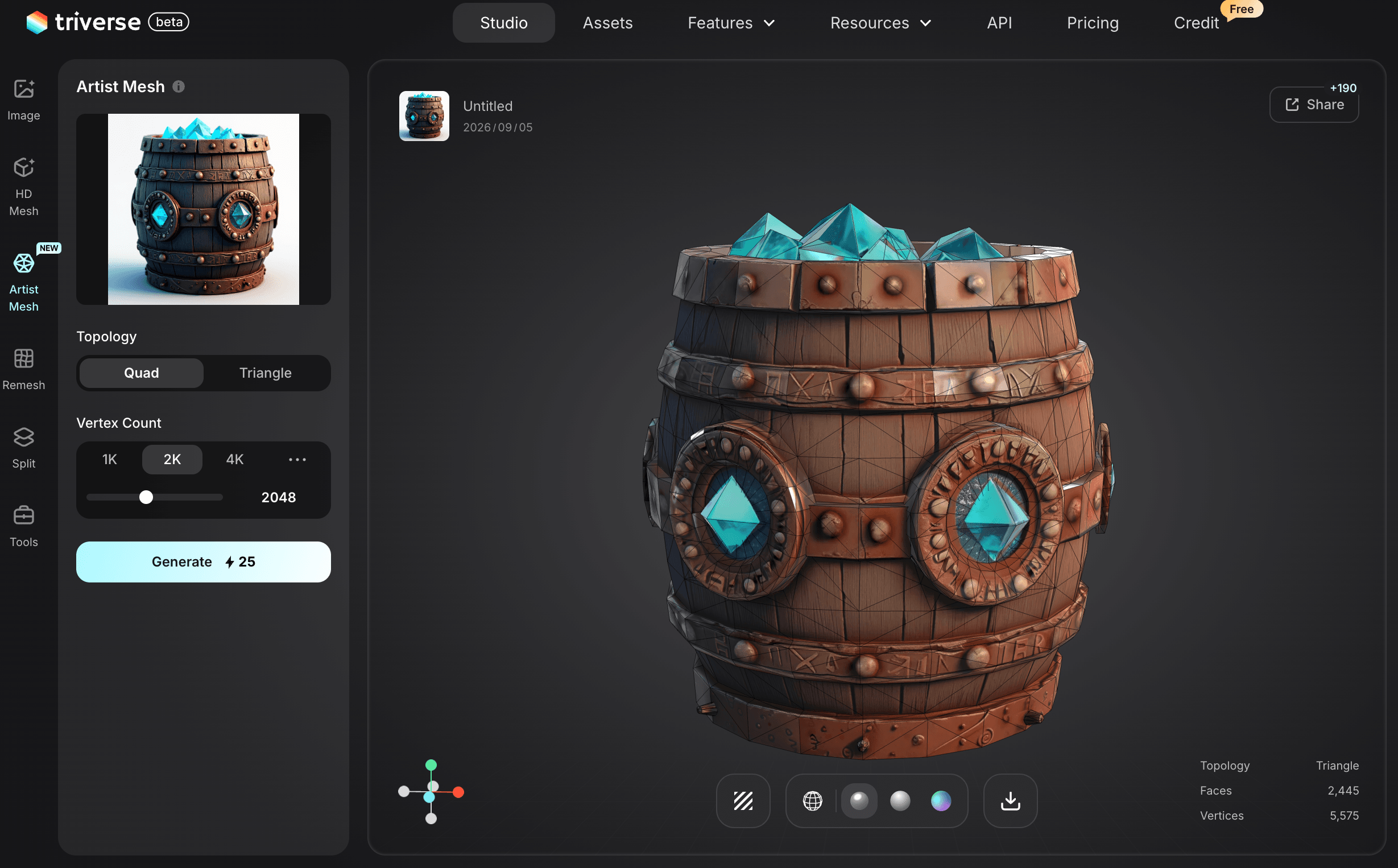
This is the fastest way to a convert concept art or a photo into a usable game-ready prop, and the quad output keeps retopology decisions simple downstream.
HD Mesh for Text-to-3D Props with AI-Assisted Prompts
For text-to-3D, switch to HD Mesh and write a descriptive prompt. HD Mesh accepts both image and text input, but text is where it shines for ideation: type "a rusted medieval lantern with cracked glass" and you get a high-polygon reference mesh to refine.
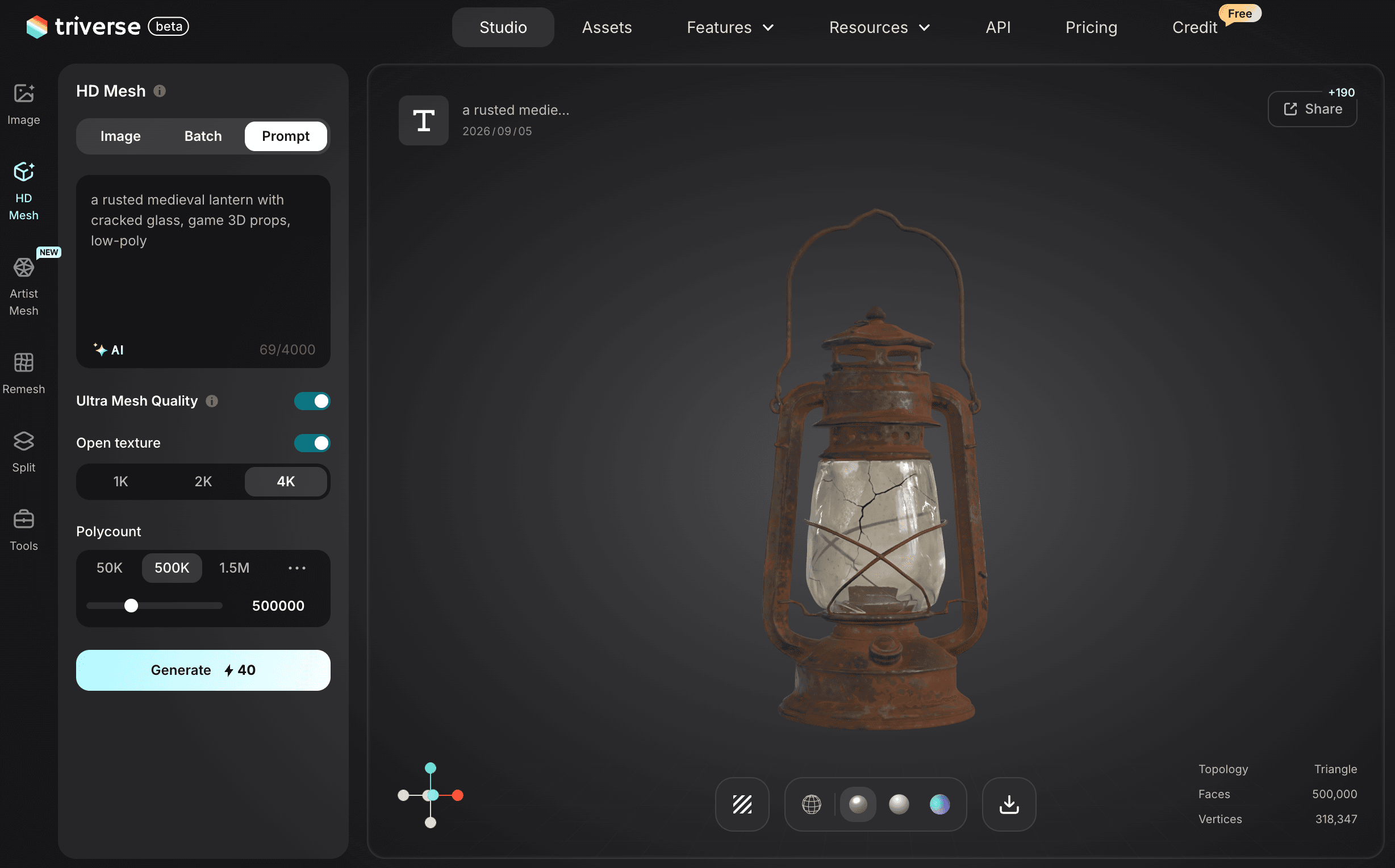
If your prompt is thin, Triverse's built-in AI assistant expands it into a richer description for you in one click, so the generation has more signal to work with. The output is dense and best used as a sculpting or baking source, then retopologized for runtime if needed.
One Tool, Both Inputs
The split above is what to use when. In practice, you can move between modes inside the same studio session: start with a text prompt in HD Mesh to explore silhouettes, lock the look by regenerating from an image in Artist Mesh, and you are at a game-ready mesh without exporting to a second tool. Picking between image and text inputs is the same question covered earlier in this guide, just answered with one tool instead of three.
From Prompt to a Clean Prop Mesh
Because the output is already retopologized, the game-ready cleanup step is shorter. Triverse exports GLB and OBJ that you can bring straight into Unity or Unreal. Be honest about the limit: a generated prop still needs a scale and pivot pass, and complex props may want a quick retopo touch-up before they ship. Blender's PBR workflow documentation covers how PBR textures behave under different lighting, which matters if you are baking or editing the generated maps.
Bottom Line
Generate 3D props from image or text prompts, and the fastest route depends on what you already have. No reference: start with text and iterate until the silhouette clicks, then lock it with an image pass. Have concept art or a photo: feed that directly and let an AI 3D model generator like Triverse AI match it. Either way, plan 15 to 45 minutes of cleanup per prop, and the workflow is fast enough to build a full asset pack in a day.
FAQs about Generate 3D Props From Image or Text Prompts
Can I generate 3d props from image or text prompts?
Yes. Most AI 3D tools accept either a written prompt or a reference image and return a textured 3D prop. Text is better for ideation and variants; an image is better when you must match a specific reference.
When should I use text instead of an image for props?
Use text when you are exploring ideas, want many variations fast, or have no reference. Use an image when you already have concept art, a photo, or a sprite you need to match exactly.
How do I write a good prop prompt?
Use four parts: the subject, the material, the style (low-poly, stylized, realistic PBR), and the details. Move from "a crate" to "a weathered wooden crate with metal bands, low-poly style" and the result improves at each step.
What format should I export props in for games?
GLB and FBX both work. GLB is one self-contained file with embedded textures, good for quick iteration. FBX carries more rigging and animation data, better for complex props. Unity and Unreal both import either.
Are generated props game-ready on their own?
Not fully. They need cleanup: make the mesh watertight, retopologize if needed, set the real-world scale, and place the pivot at the base. Plan 15 to 45 minutes of polish per prop for a full asset pack.
Can I generate props inside Unity or Unreal directly?
Unity has an in-editor AI assistant that creates 3D objects from a phrase. Unreal relies on plugins and external generators, then imports the result as a GLB or FBX.
What is the best AI tool to generate 3D props?
The best tool is the one that exports a standard editable format and lets you control polygon count. Meshy, Tripo, Triverse AI are common picks, each with different strengths for text, image, or engine-native output.