Procedural Asset Generation for Games: Benefits, Tools, and Workflow
Procedural asset generation can cut world-building cost and scale variation. See the real benefits, when it backfires, and how to pick procedural, manual, or AI.
September 9, 2026
Imagine you are building an open-world RPG. Your game needs forests, and your designers want every tree slightly different. Placing each one by hand is not an option, you would be there for months. Procedural asset generation is the answer: write the rules once, and the engine places ten thousand trees that all follow your visual language without you touching each one.
That is the promise. The reality is more nuanced. Procedural generation does not eliminate work, it shifts it upstream. Before you benefit from it, you have to author the system that makes it possible. And that system has real costs, real limitations, and a specific set of problems it solves better than others.
This article breaks down what procedural asset generation actually does for game developers, where it wins, where it fails, and how a hybrid pipeline is now the practical path for studios of any size.
What Procedural Asset Generation (PCG) Actually Means
Procedural asset generation means using algorithms and rules to create game assets automatically. Instead of a 3D artist modeling every fence post individually, a developer defines parameters: height, width, post spacing, wood grain style, and the system generates fence variations from those rules.
The key concept is the seed. A seed is a number that initializes the random number generator. With the same seed, you get the same world every time. Change the seed, and you get a new but stylistically consistent variation. This is what makes procedural worlds reproducible and debuggable. Unlike true randomness, seed-based generation lets you share exact world states with your team or revert to a specific layout.
The three families of procedural tools each work differently.
Mathematical and noise-based generation
These systems use functions like Perlin noise, Simplex noise, or cellular automata to create terrain, foliage distribution, or cave systems. These are the oldest forms of procedural content, and they are deterministic, the same seed always produces the same output.
Rule-based and graph-based systems
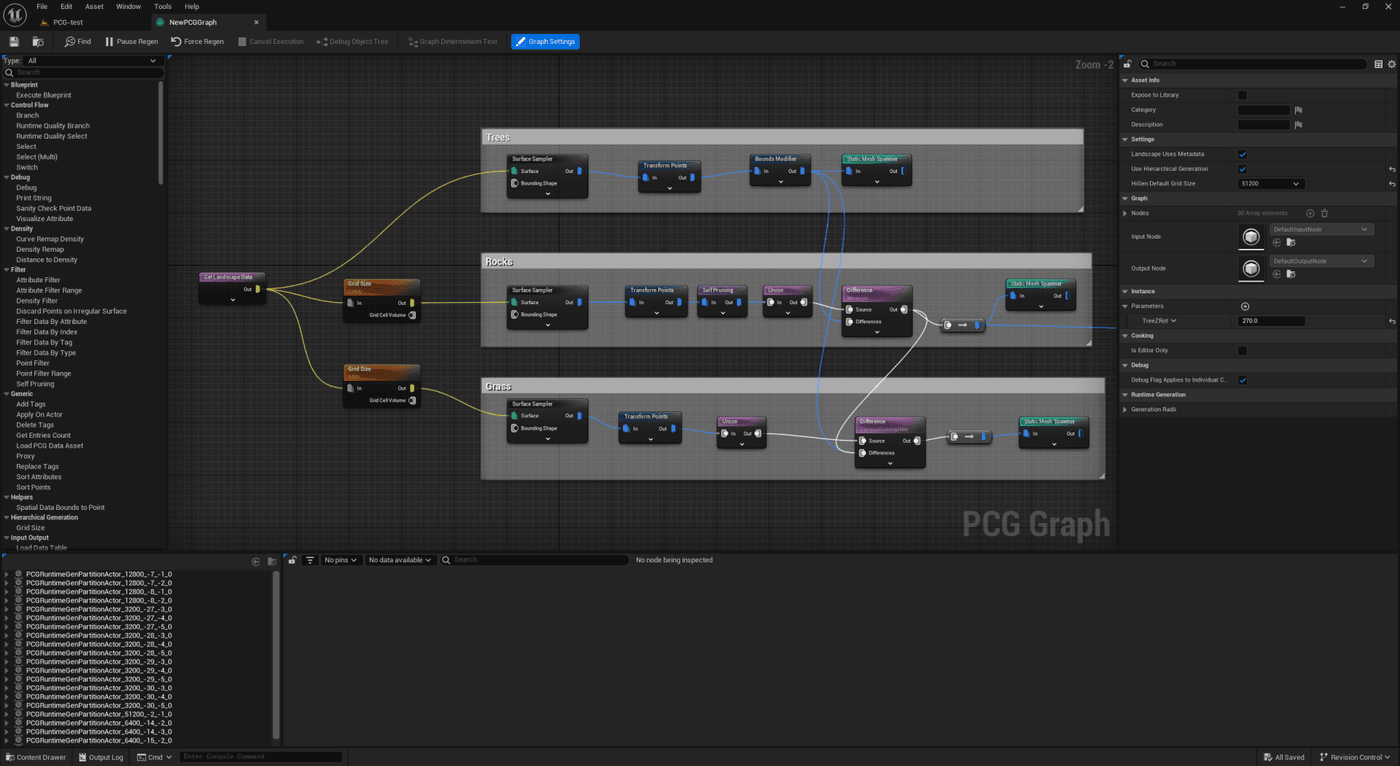
These let artists define explicit rules and parameters. Unreal Engine 5's PCG Framework uses node graphs where each node represents a rule: spawn this asset here, rotate it randomly within this angle range, density based on proximity to water. Houdini takes this further with a full procedural node network that can generate anything from rocks to entire city blocks.
AI-based generation
This is the newest category. Text or image prompts produce 3D models directly, bypassing rule authorship entirely. This is not procedural in the classic sense, the rules are learned from training data rather than authored by hand, but it occupies the same pipeline slot: generating assets without per-asset manual labor.
The Core Benefits for Game Developers
The appeal of procedural generation is not that it is free. It is that it amortizes the cost of variation over time. Here is what that means in concrete terms.
Scale without linear cost
A handcrafted forest with 10,000 unique trees requires 10,000 units of artist time. A procedural forest with 10,000 variations from 5 base tree meshes and a scatter system requires one artist building the base meshes plus one technical artist authoring the scatter rules. The 10,000 variations come essentially free after that.
Variation and replayability
Each seed produces a different world. Players who replay your roguelike or open-world game get a genuinely different experience, not just reshuffled encounters. Hades II, Caves of Qud, and No Man's Sky all depend on this property at their core.
Smaller builds and runtime memory
When you ship a procedural world, you ship algorithmic rules and seeds, not the rendered assets. A seeded terrain system might be megabytes of parameters. The same terrain as pre-built meshes could be gigabytes. For large open worlds, this is not a detail.
Seed-Based Determinism and Why It Matters
The seed is what makes procedural output reproducible. The same seed number always produces the same result, which means your team can share exact world states, QA can replicate a specific layout, and you can regenerate identical worlds across updates. Without that determinism, you lose the ability to collaborate on or debug a specific generated scene. This property is why games like No Man's Sky and Dwarf Fortress can describe world coordinates to players and have them visit the same location.
Faster iteration and cheap late changes
Want to double the forest density after playtesting? Change a density parameter and regenerate. In a handcrafted world, that means redoing weeks of placement work. In a procedural one, it is a slider.
Consistency at scale
Rules enforce style. A handcrafted world relies on every artist remembering the art bible. A procedural system applies the art bible automatically.
Here is a quick comparison of the practical impact across the benefits that matter most:
Benefit | What It Means in Production | When It Matters Most |
Scale without linear cost | One system produces thousands of variations | Open worlds, roguelikes, survival games |
Variation and replayability | Procedural dungeons, infinite runners | |
Build size and memory | Ship rules, not rendered assets | Large-scale worlds, mobile games |
Iteration speed | Parameter changes propagate everywhere | Any project with late-stage design changes |
Style consistency | Rules enforce art direction | Studios with multiple environment artists |
Procedural vs Manual vs AI: A Decision Framework
This is where most guides stop. They tell you procedural generation is great and move on. But choosing the wrong method for a given asset type is expensive. Here is a practical decision matrix.
Where procedural wins
Procedural generation is the right choice for high-volume, non-focal content where variation matters more than precise placement. Forests, rocks, debris fields, distant buildings, scattered props, loot tables, enemy spawns, these are the natural territory of procedural systems.
Where manual still wins
Handcrafted work is irreplaceable for hero assets, narrative focal points, rigged characters, and anything that lives in close-up gameplay. A boss encounter set piece, a protagonist character, or a prop that the player examines closely, you want an artist's judgment shaping those, not a noise function.
Where AI generation fits
AI tools like Triverse sit in the gap between procedural and manual. You need one-off props, modular assets for a specific game, or reference-based variations. Think of the same chest model in three different wood tones, or a weapon family that shares proportions. These do not justify building a Houdini procedural system, but doing them manually is slow. AI generation covers exactly this tier.
Factor | Procedural Generation | Manual Art | AI Generation |
Setup cost | Medium to high (author rules) | Zero (start from blank) | Near zero (prompt or image) |
Control over output | High if rules are precise | Maximum | Moderate (prompt-dependent) |
Variety potential | Extremely high | Limited by artist time | High for one-off variations |
Quality ceiling | Limited by rule authorship | Highest | Good, cleanup often needed |
Iteration speed | Fast (parameter change) | Slow (redo work) | Fast (re-generate) |
Best for | Bulk background content | Hero focal assets | One-off props and modular sets |
If you are building a game where scale and variation are core pillars, an open world, a roguelike, a survival crafting game, procedural generation should be in your pipeline. If you are building a narrative 4-hour experience where every frame is curated, manual work dominates. For most studios, the answer is both.
The Workflow: From Rules to Shipped Assets
Procedural generation is not a button you press. It is a pipeline you build. Here is how it actually works from start to finish.
Define the asset library first
Before you author a single rule, decide what gets proceduralized and what does not. A common mistake is proceduralizing too much, flooding your game with generated assets that feel random rather than designed. Start with a clear list: what assets does the game need, in what quantities, at what LOD?
Author the rules
This is the real work. For a scatter system, you define which meshes spawn, their rotation ranges, scale variation, slope and height constraints, clustering behavior, and density falloff by distance from player. For a terrain system, you define noise octaves, erosion parameters, biome transitions, and mesh-versus-billboard LOD switching. For Houdini, you are writing a node network that outputs game-ready assets. Budget significant time here. This is where the quality of your world lives or dies.
Generate, scatter, and validate
Run the system and review the output. Check for floating objects, clipped geometry, z-fighting, and performance spikes. Automated validation scripts that flag non-manifold geometry, missing collision meshes, or exceeding poly count budgets catch problems before they reach playtesting.
Offline versus runtime generation
There are two modes. Offline generation runs the system once, produces a static world, and ships that world as data. Runtime generation runs the system in real time as the player explores, generating new content on demand. Offline is simpler and easier to validate; runtime is more memory-efficient and enables truly infinite worlds. Unreal Engine 5's PCG Framework supports both.
Integrate into your engine pipeline
Export generated assets in the right formats. Static meshes in glTF or FBX for engine import, terrain data in your engine's native format, scatter data as runtime spawner components. This is where the gap between generated and game-ready closes, with proper pivot point setting, collision mesh configuration, and LOD groups.
For more on environment modeling workflows and how they fit into a game development pipeline, see our guide to how game environment modeling isProcedural Asset Generation for Games: Benefits, Tools, and Workflow. For modular low-poly environment assets and what makes a 3D model game-ready for engine import, check what makes a 3D model game-ready.
Tools of the Trade
The procedural generation tool landscape has grown significantly. Here are the major options.
Unreal Engine 5 PCG and Unity Terrain
The Unreal Engine 5 PCG Framework gives you a node graph environment for building world generation systems directly inside the engine. PCG Graphs support both editor-time and runtime execution, world-aware spawning, and hierarchical data organization through templates. If you are already in Unreal, this is the lowest-friction entry point.
Blender Geometry Nodes is free and powerful for procedural modeling and scatter systems. It works inside Blender's existing asset pipeline and exports to any engine. The node system is less mature than Houdini's for complex procedural networks, but it is accessible and constantly improving.
SideFX Houdini is the industry standard for procedural game asset pipelines. Studios like Naughty Dog, Guerrilla Games, and Ubisoft use Houdini to build the systems that generate their open worlds. The Indie license at $270/year makes it accessible for smaller teams. The tradeoff is a steep learning curve. Houdini's node system is genuinely different from anything else in 3D.
Substance Designer handles procedural materials and textures. It is the right tool for generating base materials, decals, and surface variations that follow a defined style without looking repetitive.
AI-based generators, including Meshy, Sloyd, and Tripo, handle the "I need a few good-looking props quickly" use case. They do not replace procedural systems, but they fill the gap below the threshold where building a procedural pipeline is worth it. These tools are useful to name in context, but they are not linked here because they are direct competitors to Triverse.
For a broader look at how AI tools compare across the game development workflow, see our comparison of AI 3D model generators for game development.
The Pitfalls Nobody Mentions
Most procedural generation content stops here. It lists the benefits and calls it a day. That is irresponsible. Here is what actually goes wrong.
Repetition fatigue
Players notice repetition faster than you expect. A forest generated from 5 tree meshes using randomized scale and rotation will start feeling same-y after a few hours. The fix is not more randomness, it is more distinct base assets and a denser variation parameter space. But that means more upfront work, which studios often skip.
The sterile look
Pure procedural output lacks authored character. A handcrafted environment tells a story through selective placement. This barrel is here because someone left it here. A procedural scatter places barrels according to a rule that maximizes coverage, not narrative coherence. The result is technically correct but emotionally flat. This is why the best procedural worlds still have artists hand-placing hero props and narrative elements inside an otherwise procedurally generated space.
Performance debt
Runtime procedural generation has real costs. Generating terrain or spawning entities on the fly consumes CPU and memory that could be rendering frames. Solutions exist, like chunking, LOD, async loading, and object pooling, but they require engineering time that smaller studios often underestimate.
The art direction gap
Procedural systems enforce consistency through rules, but rules do not have aesthetic judgment. Without a clearly defined art bible that translates into rule parameters, procedural systems drift. The classic symptom is a world that looks technically correct but tonally inconsistent.
Be honest with yourself before committing to a procedural pipeline: does your team have the technical art capacity to author good rules, or will you end up with mediocre rules that are faster to build than good art but produce worse results than either? Procedural generation does not replace technical artistry. It gives technical artists a more powerful tool.
Building a Hybrid Pipeline That Ships
The studios that use procedural generation most successfully do not use it exclusively. They build hybrid pipelines that allocate each asset type to the method that fits it best.
Procedural for bulk
Background foliage, distant buildings, rock fields, debris, scattered props, anything where the player sees it from a distance and does not focus on it closely. This is where procedural earns its keep: high volume, low scrutiny.
Manual for heroes
Focal props, narrative set pieces, characters, and anything the player examines closely. An artist makes these once, and they carry the visual weight of the world. You do not proceduralize your protagonist's face.
AI for the middle
Here is where Triverse fits. One-off props that do not appear in enough quantity to justify a full Houdini setup, modular asset families that share proportions but differ in detail, or reference-image-based variations for a specific game. These are the AI generation sweet spot. It is faster than manual and more intentional than pure procedural.
A practical example: a fantasy RPG needs 40 unique weapon props for its merchant inventory. Building a procedural scatter system for weapons is overkill. Paying an artist to model 40 individually is expensive. Generating them with Triverse from a handful of reference sketches and variations, a sword family, an axe family, a mace family, gets you to 40 distinct, engine-ready assets in an afternoon.
Where AI Generation Fits in Your Pipeline
Triverse AI occupies the part of the asset pipeline that procedural systems are too expensive to automate and manual work is too slow to scale.
Artist Mesh for clean topology props
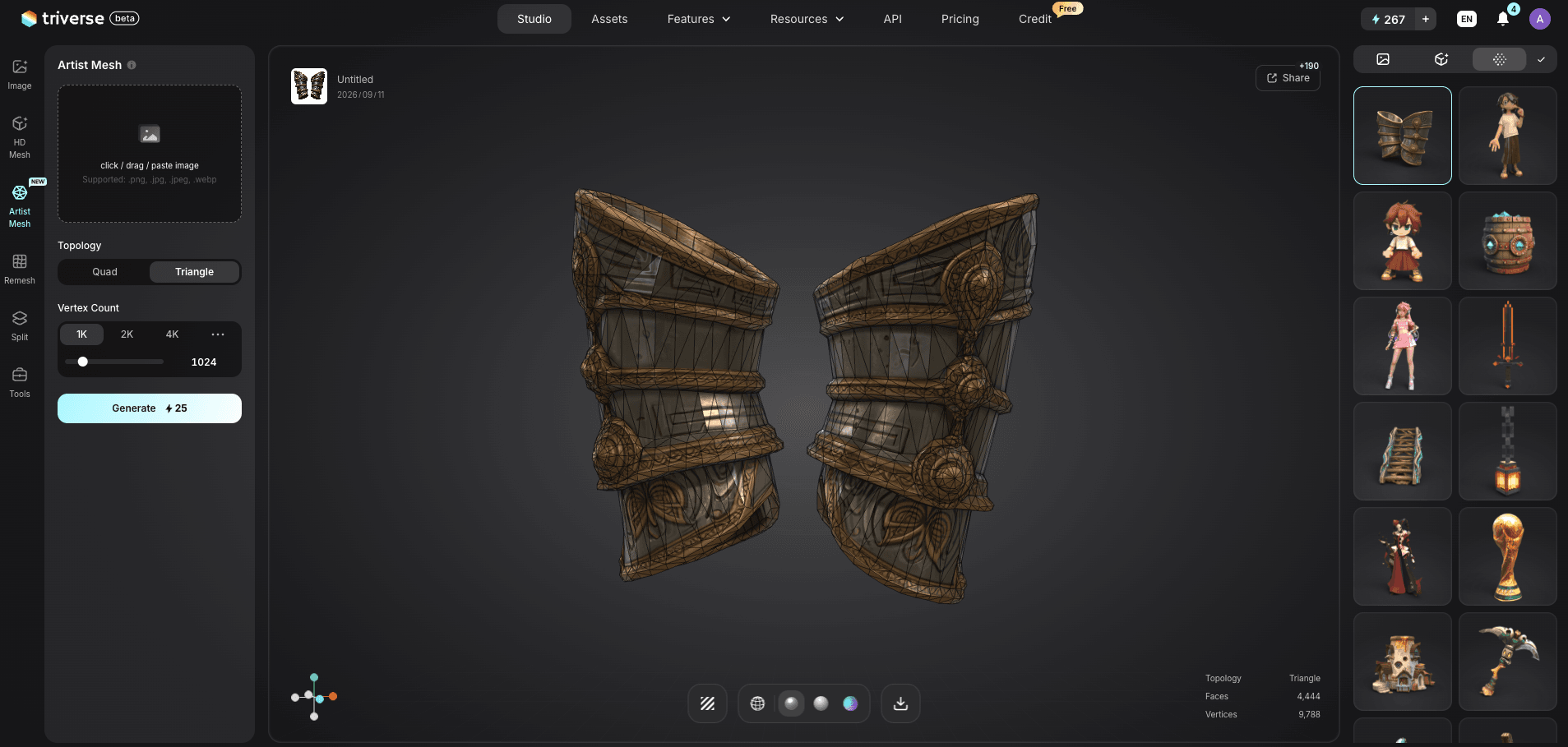
Upload a PNG or JPG reference image, a concept sketch, a photograph of a prop, a style reference, and Triverse Artist Mesh produces a clean triangle mesh with preset vertex counts of 1K, 2K, or 4K. The output is engine-ready: clean topology, no retopo needed for most prop and environment use cases. Fixed cost of 25 credits per generation.
HD Mesh for high-poly bakes
When you need denser geometry for baking normal maps or creating high-to-low source meshes, Triverse HD Mesh produces higher polygon counts. Use this as your high-poly source for a hand-painted or baked normal map workflow before decimating to your target game resolution.
Split and Iterate
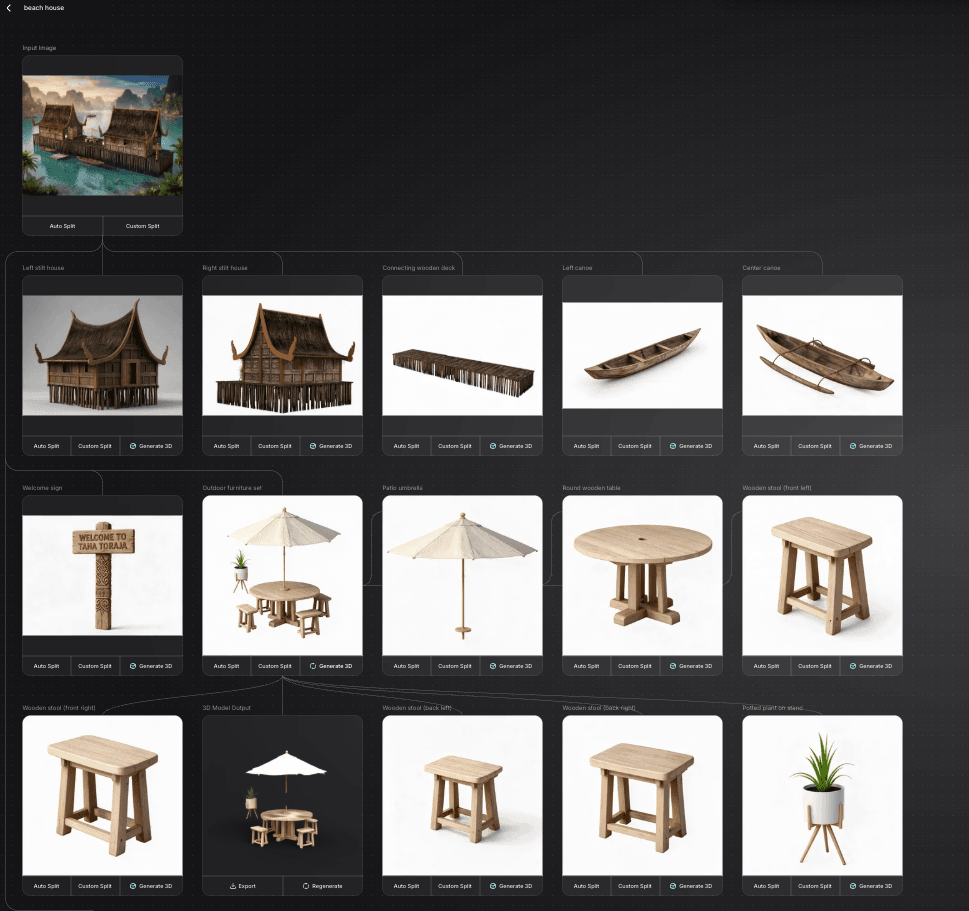
Upload a single character concept art or prop reference image; Triverse Split auto-detects and segments each component into separate cards, then generates each one individually. Regenerate any card without re-uploading. This is the batch workflow that makes one reference image produce a full prop set. This is live on Triverse Studio today. A single character sketch with armor, weapons, and accessories becomes a modular asset set where each piece can be generated, iterated, and exported independently.
For generating individual 3D props from image or text, see our full guide on how to generate 3D props from image or text prompts. For cleanup before engine import, the key steps are checking for non-manifold geometry, running a decimate modifier to hit your target poly count, and verifying UV island layout.
Bottom Line
Procedural asset generation is not magic. It is a system that trades upfront authoring time for downstream scalability. It works best for high-volume, non-focal content in games where variation and scale are core design pillars. For open worlds, roguelikes, survival games, and large multiplayer environments, procedural generation is often the only way to populate a world at the required scale without blowing your budget.
The honest caveat: it does not replace art direction. Rules enforce style only as well as they are authored. Studios without a strong technical art function will get technically consistent but aesthetically mediocre results.
The practical answer for most teams today: use procedural generation for bulk background content, handcrafted art for focal assets, and AI generation for the middle tier: one-off props and modular asset families that sit between "too many to model manually" and "worth building a Houdini pipeline for." Triverse covers that middle tier directly.
Frequently Asked Questions about Procedural 3D Asset Generation
What are the advantages of procedural asset generation for games?
The main advantages are scale without linear cost, built-in variation and replayability, smaller build sizes and runtime memory (you ship rules and seeds rather than pre-built assets), faster iteration on world design, and automatic style consistency enforced by rules rather than individual artist judgment.
Is procedural asset generation the same as AI generation?
No. Classic procedural generation uses authored rules, noise functions, and seed-based randomness to generate content deterministically. AI generation uses machine learning models trained on existing data to produce assets from text or image prompts. They occupy similar pipeline roles. Both reduce per-asset manual labor, but work through fundamentally different mechanisms. Many modern pipelines use both.
When should I not use procedural generation?
Avoid procedural generation when quality and intentionality matter more than scale. Hero assets, narrative focal props, rigged characters, and anything the player examines closely should be handcrafted. Procedural systems also require significant upfront investment in rule authoring and validation. For smaller projects with limited technical art capacity, the setup cost may exceed the benefit.
Does procedural generation reduce game development costs?
For the right project, yes. The cost model is front-loaded: authoring rules takes time and technical art skill. Once the system exists, generating content at scale is cheap. For open worlds, roguelikes, and survival games that require thousands of assets, procedural generation can reduce art production costs dramatically compared to fully manual pipelines. For small linear games with hundreds rather than thousands of assets, the upfront cost often does not pay off.
How do I stop procedurally generated assets from looking repetitive?
Increase the variation parameter space. Use more base mesh variants rather than fewer, expose more rotation and scale controls, add rule-based variation in material and color parameters, and layer secondary detail systems. The repetition problem is usually a sign that the procedural system was under-authored, not that procedural generation itself failed.
Can procedural assets be used in Unreal Engine or Unity?
Yes. Both engines have native support for procedural content. Unreal Engine 5 has the PCG Framework with native node graph authoring and runtime generation. Unity supports procedural approaches through its Terrain system, Prefab-based scatter, and third-party tools like MapMagic or Gaia. Both engines also support runtime loading and spawning of procedurally generated content.
How much setup does procedural asset generation require?
It depends on the tool and the scope. A basic Blender Geometry Nodes scatter system for a small game can be set up in a day. A full Houdini procedural pipeline for a AAA open world can take months to build and validate. The honest answer is: more than most first-time procedural users expect. Budget 2 to 4 weeks for a solid, validated procedural system for a mid-size game, and significantly more for complex world generation systems.