AI Texturing (Based on Image/Text)
March 23, 2026Triverse AI's Texturing feature lets you apply new materials and styles to existing 3D models.
Already have a great model? Transform it into "Winter," "Desert," "Cyberpunk," or any other variant without re-modeling.
Texturing Tips
A good texture reference or prompt gets you better results. Here's how to approach it.
Do's (Best Practices) | Don'ts (Things to Avoid) |
|---|---|
✅ Use clear reference images: high-contrast, well-lit texture photos work best | ❌ Avoid blurry or low-contrast references |
✅ Be specific with prompts (e.g., covered in green moss and mud is better than mossy) | ❌ Avoid overly complex textures |
✅ Match the scale: if texturing a small object, use close-up texture references | ❌ Avoid too many details at once ( e.g., usty, wet, covered in moss, with gold accents is too complex) |
✅ Test variations: generate multiple textures to find the best look | |
✅ Consider context: think about where the model will be used (game, render, print) |
Example: Creating Texture Variants of a Traffic Cone
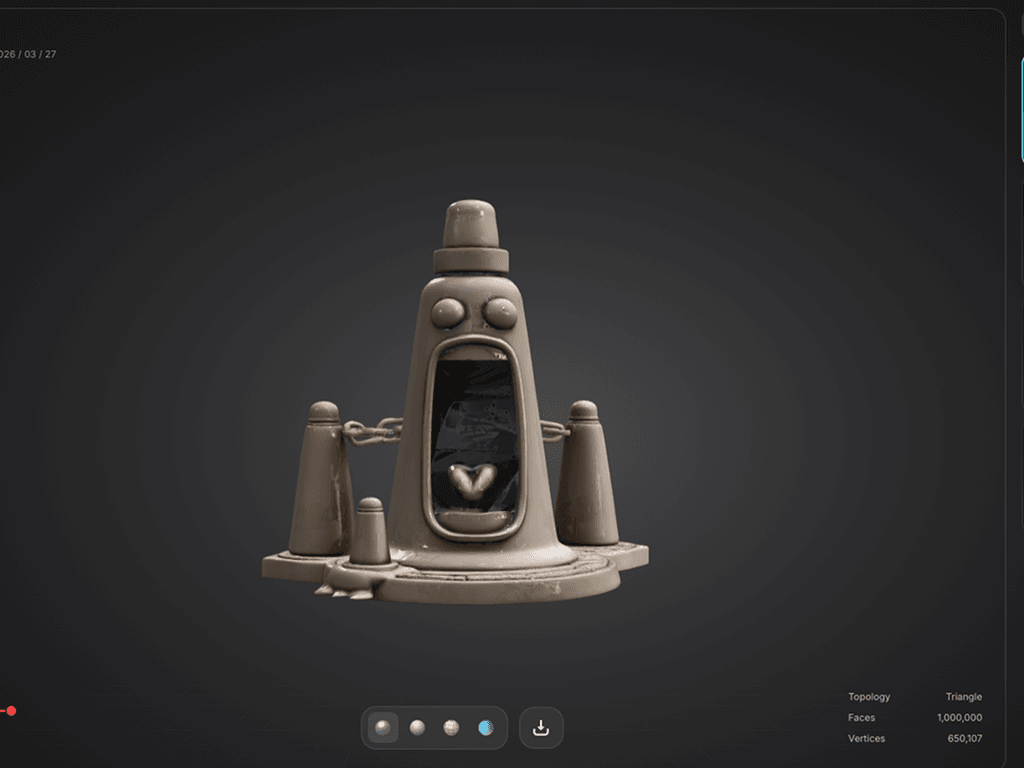
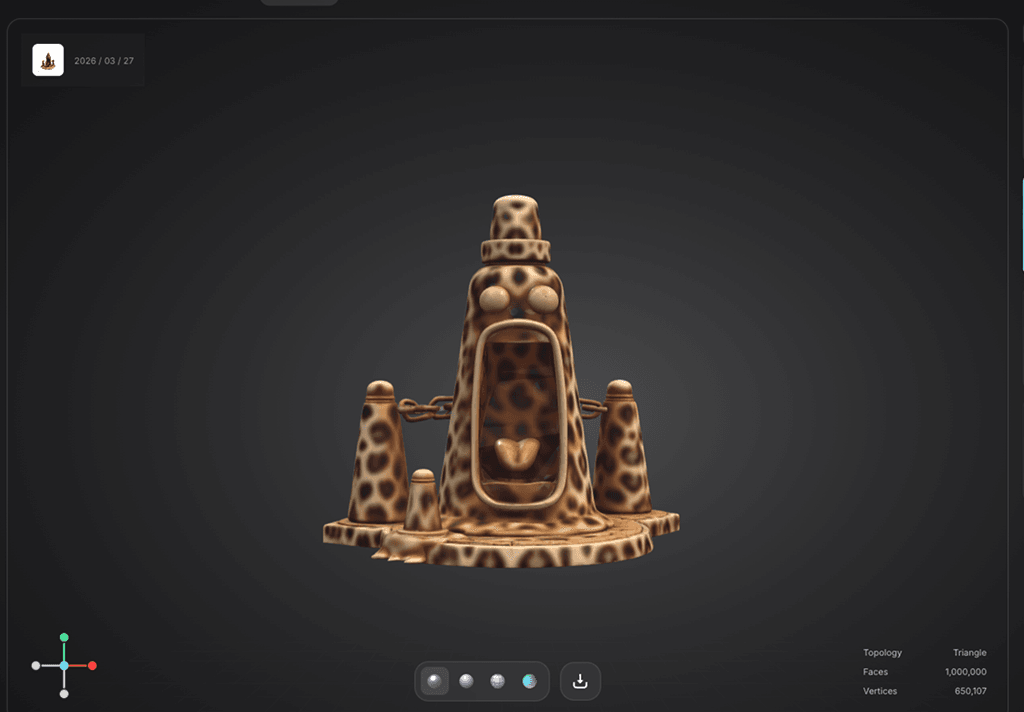
Let's walk through a real example: taking a basic traffic cone model and creating multiple texture variants (rainbow, marble, leopard print) using different reference images.
Step 1: Load Your Model
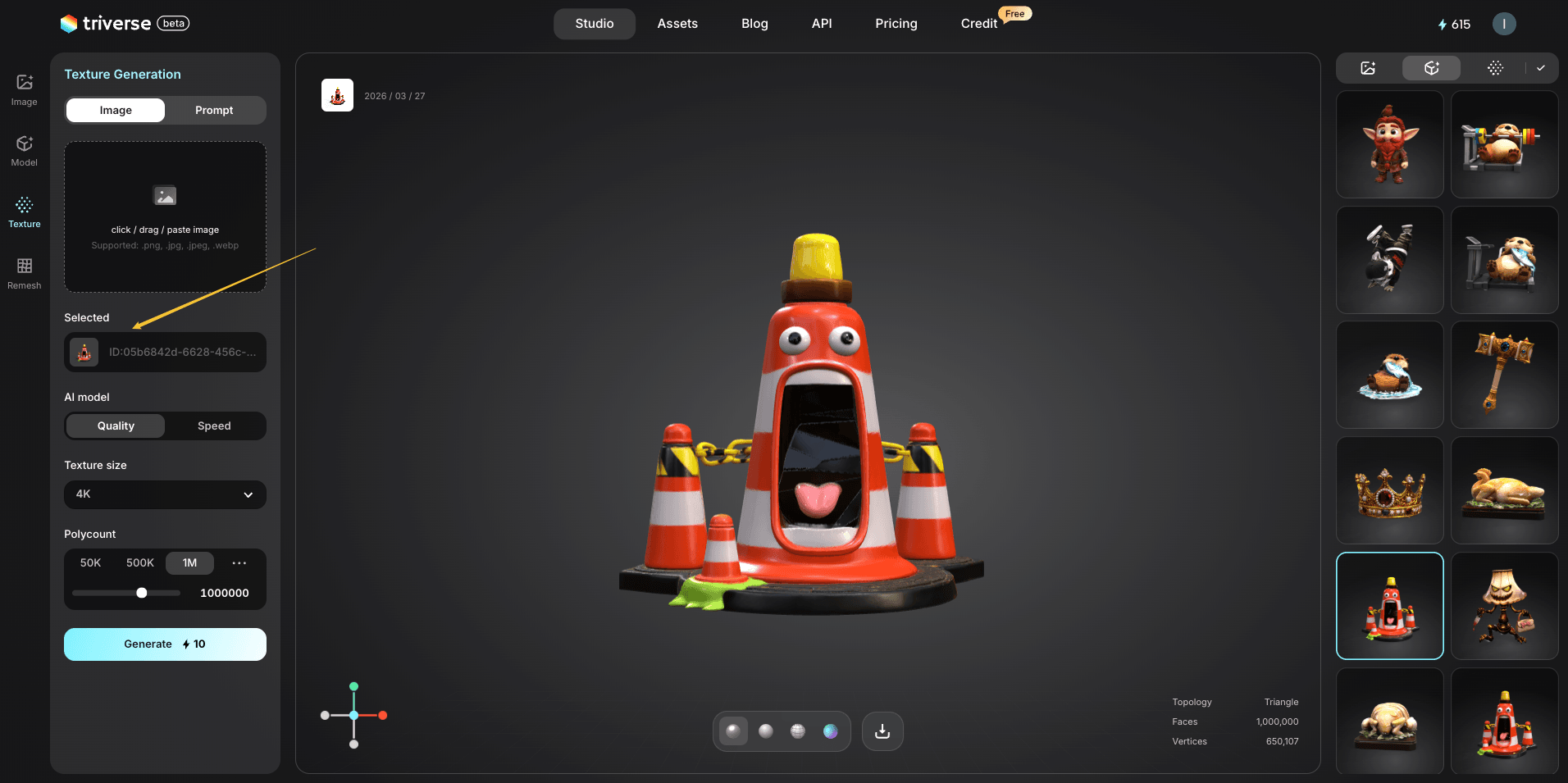
Go to Triverse Studio. Then click the Texture icon on the left panel.
Choose your traffic cone model from your asset library and load it into the viewport.
Step 2: Choose Your Input Method
You have two options:
- Option A: Text Prompt
Describe the texture you want: "rainbow gradient stripes", "marble stone texture", "leopard print spots".
- Option B: Reference Image
Upload a photo of the texture you want to apply: a marble tile, leopard fur, rust, fabric, etc.
For this example, we'll use reference images.
Step 3: Upload Texture Reference & Generate
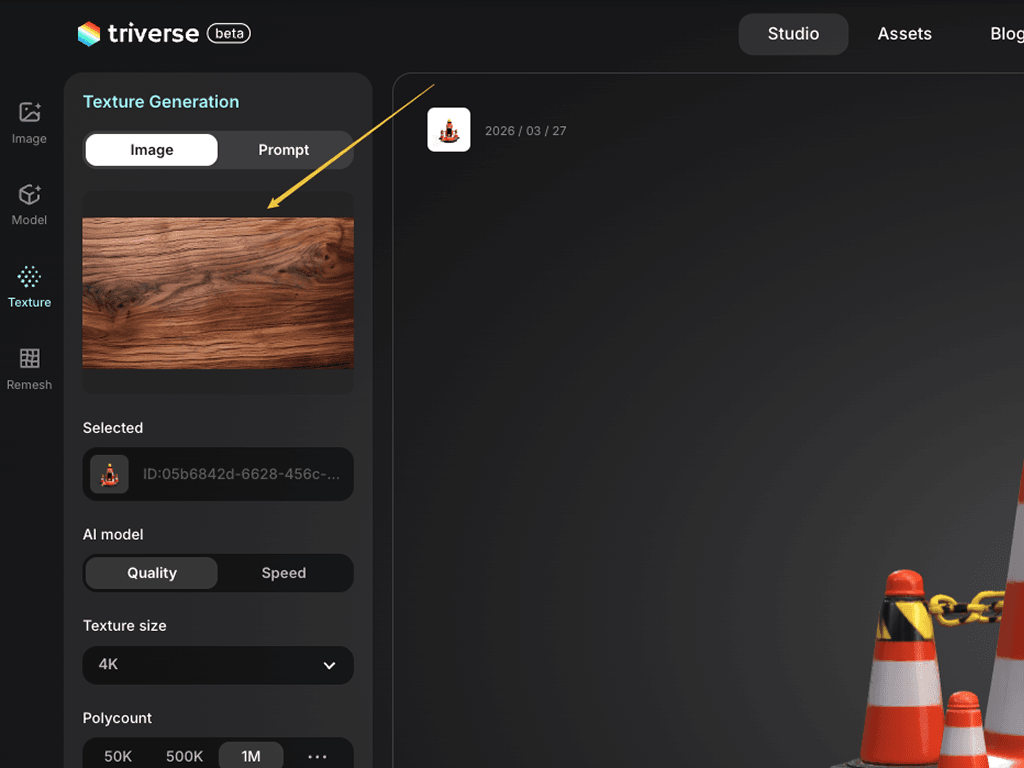
Upload your first reference image (e.g., a marble tile photo).
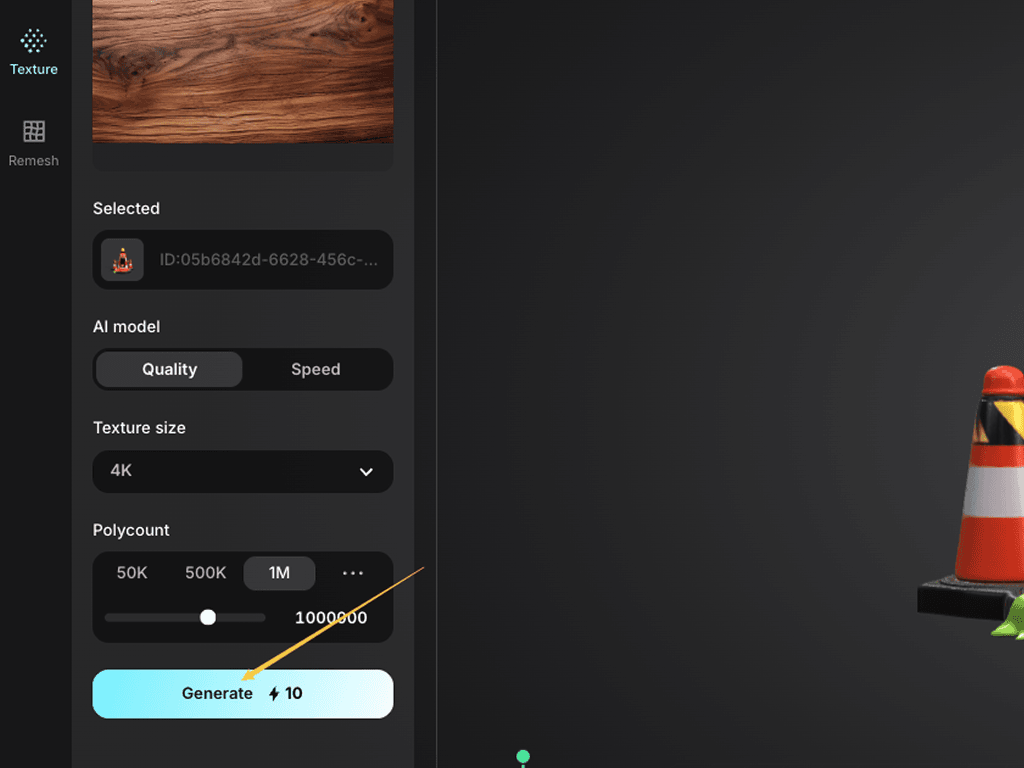
Select texture resolution (up to 4K), then click Generate.
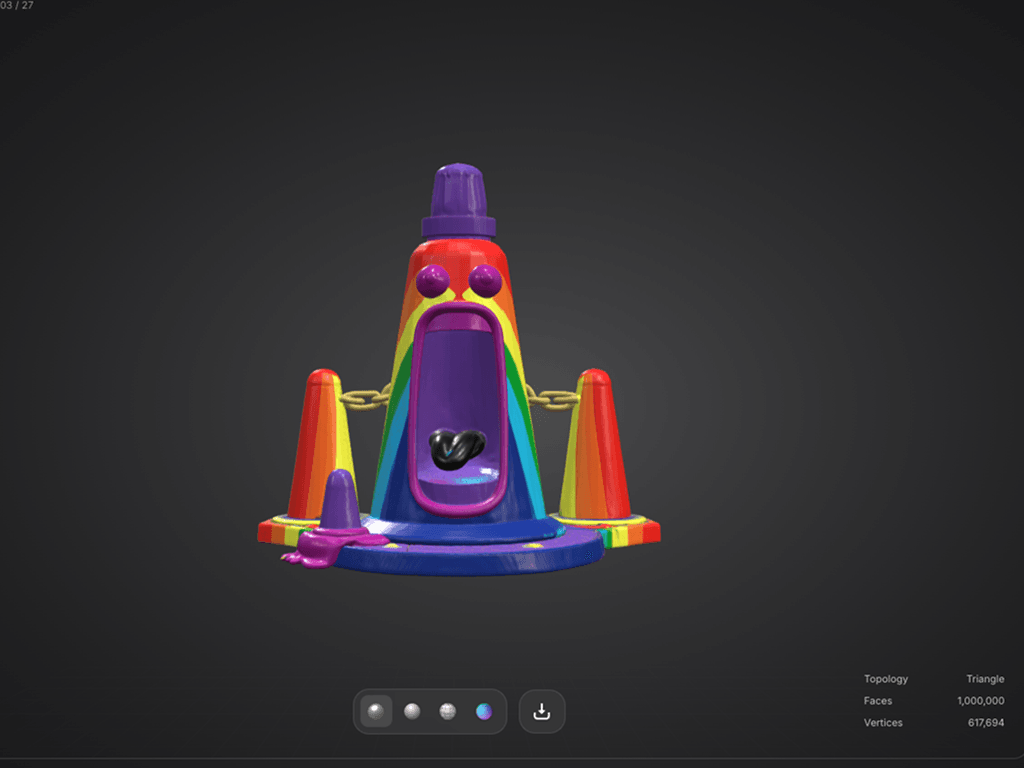
Triverse applies the marble texture to the traffic cone. The model geometry stays the same, only the surface appearance changes.
Step 4: Try Different Looks
Repeat the process with different reference images:
Generation Settings
Now that you've seen the full workflow, here's what each setting actually does, and when to change it.
AI Model: Quality vs. Speed
Quality | Spped | |
|---|---|---|
Generation time | ~90s | ~60s |
Mesh accuracy | High | Medium |
Best for | Hero assets, characters | Prototyping, background props |
Texture Size: 1K / 2K / 4K
Texture size controls how sharp the surface detail looks up close
1K (1024×1024) | 2K (2048×2048) | 4K (4096×4096) | |
|---|---|---|---|
File size | Small | Medium | Large |
Detail | Low | Medium | High |
Best for | Mobile, background props | General use | Hero assets, close-up renders |
Polycount: 50K – 1.5M
Polycount controls how much geometric detail the mesh has. More polygons = more accurate shape, but heavier on performance.
50K | 500K | 1M | |
|---|---|---|---|
Performance | Very light | Balanced | Heavy |
Shape accuracy | Low | Good | High |
Best for | Mobile, background | General use | Hero assets, rendering |
Workflow: Model → Texture Variants → Export
The real power of AI Texturing is creating multiple asset variants from a single model.
Step 1: Generate or import your base 3D model
Step 2: Apply Texture Variant A (e.g., marble)
Step 3: Export as texture_marble.GLB / .OBJ / .STL / .3MF / .FBX / .USDZ
Step 4: Apply Texture Variant B (e.g., rust)
Step 5: Export as texture_rust.GLB / .OBJ / .STL / .3MF / .FBX / .USDZ
Step 6: Repeat for as many variants as you need
This saves massive amounts of modeling time — you only model once, then texture multiple ways.
Best Use Cases
- 🎨 Style variations: Create ice, fire, toxic, or seasonal skins for a single asset.
- 🔄 Asset modernization: Upgrade and re-texture low-resolution models from your legacy library.
- ⚡️ Rapid iteration: Test multiple looks without re-modeling.
Try It Now
Head to Triverse Studio and generate your 3D models for free now!