Text to 3D
March 23, 2026Triverse AI's Text to 3D feature lets you convert a text prompt into a fully textured 3D model. It’s ideal when you only have a vague concept but no reference image.
Prompting Tips (Do's & Don'ts)
A good prompt makes all the difference. Here's how to write one that gets you the result you want:
Do's (Best Practices) | Don'ts (Things to Avoid) |
✅ Focus on a single subject per prompt | ❌ Avoid complex scenes or overly abstract ideas in one prompt |
✅ Include style descriptors (e.g., low poly, stylized, realistic) | ❌ Avoid combining too many elements in a single prompt |
✅ Use descriptive adjectives (e.g., bulky, glowing, spiky, ancient) | ❌ Avoid conflicting descriptions (e.g., metal and transparent at the same time) |
✅ Specify materials (e.g., wood, metal, stone) | |
✅ Add usage context (e.g., for 3D printing, for mobile games) |
Example: Creating a 3D Dwarf Character
Let's walk through a real example: creating a dwarf character from just a text prompt. Follow along step by step.
Step 1: Write your prompt
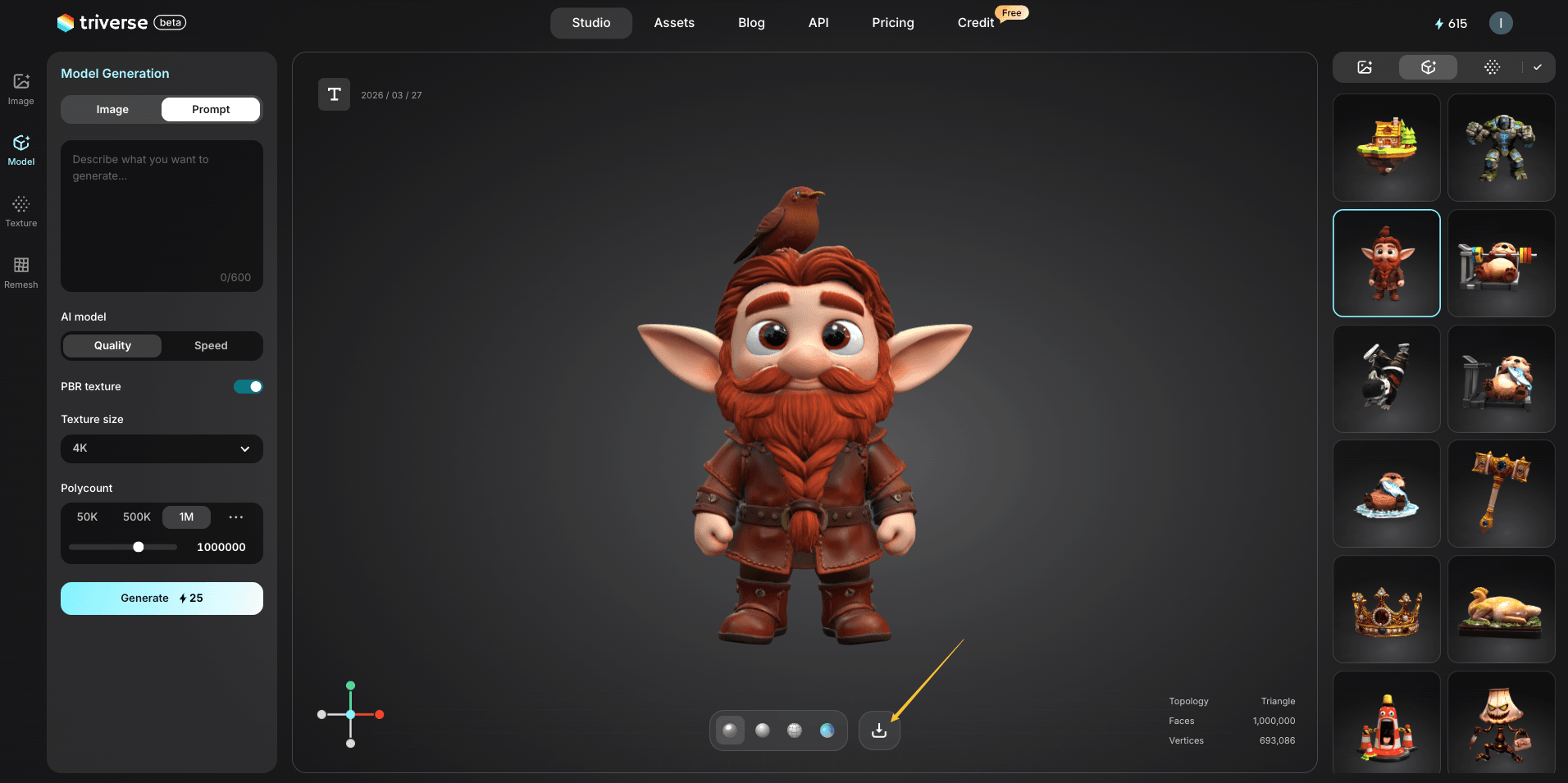
We enter a basic prompt in Triverse Studio → Model Generation → Text to 3D.
3D cartoon dwarf, chibi style, big round eyes, long braided reddish-brown hair and beard, large pointed ears, wearing a brown leather tunic and boots, a small brown bird perched on his head, white background, Pixar-like aesthetic, soft lighting, high detail, 8K resolution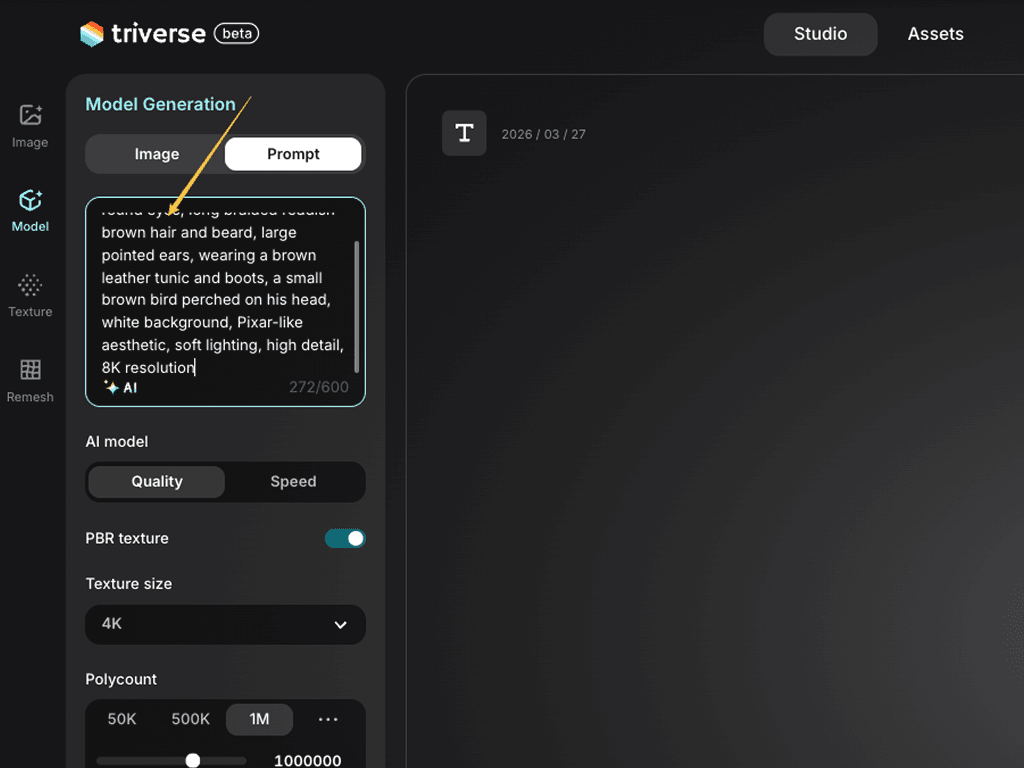
💡 Bonus: Only have a rough idea?
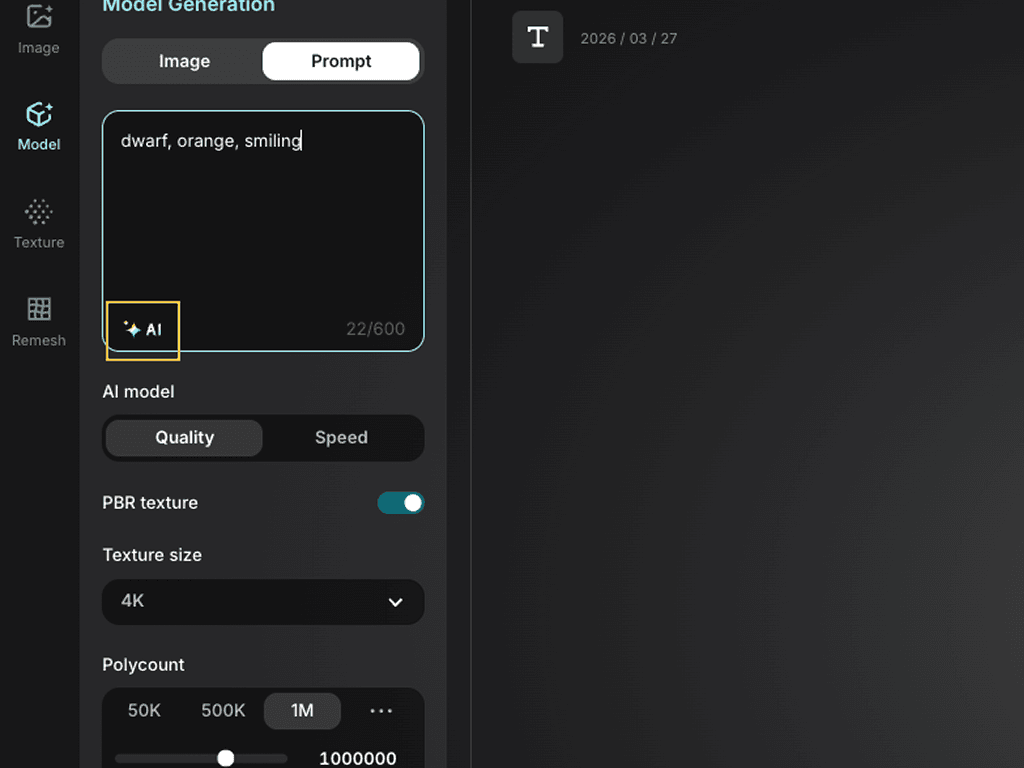
You don't need a complete prompt. You can just enter a few keywords:
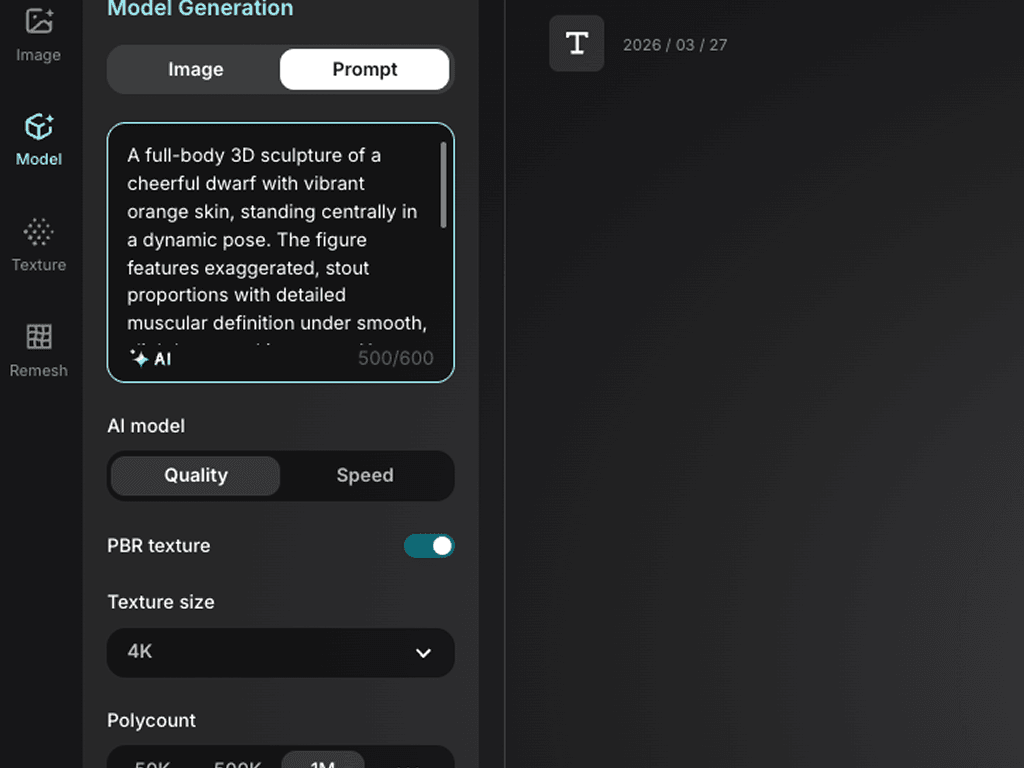
dwarf, orange, smilingThen click the AI icon next to the input box. Triverse's built-in prompt assistant will expand your keywords into a full, detailed prompt automatically.
Step 2: Adjust settings (or Keep the Defaults)
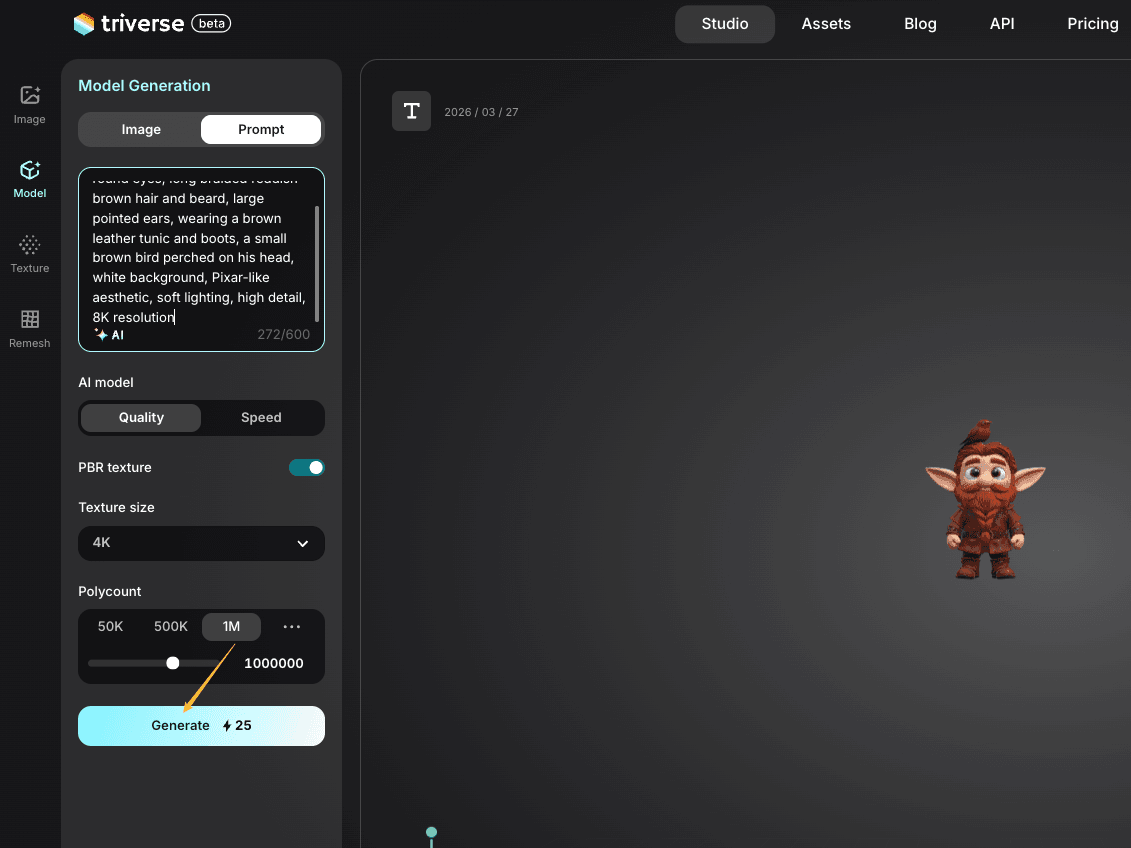
By default, Triverse uses: Quality model · PBR textures on · 4K texture · 1M polycount.
For a hero character, we keep the defaults. Click Generate.
Step 3: Review and Export
In about 90 seconds (Quality mode), Triverse produces a fully textured dwarf model.
We review it:
✅ The beard looks right — orange and full
✅ The helmet reads clearly — metal with leather straps
Click Export. Choose .GLB / .OBJ / .STL / .3MF / .FBX / .USDZ format for further use.
Generation Settings
Now that you’ve seen the workflow, here are some quick suggestions for choosing the right settings. For a more detailed explanation, please refer to the Image to 3D.
- AI model:
- Quality: better edge loops, more accurate proportions.
- Speed: great for fast iteration or batch generating props.
- PBR texture: keep it on for game assets. Turn it off only if you want a clean mesh for manual texturing later.
- Texture Size: 4K for your main character. 1K–2K for background NPCs and props.
- Polycount: 1M is great for main characters. 50K–500K for background props.
Best Use Cases
- Game Asset Production
Generate characters, weapons, props, and environment pieces from text. Perfect for rapid prototyping — describe what you need, generate it, import it into Unity, Unreal, or Godot.
- Indie Developer Workflow
Solo devs and small teams: move from concept to playable asset in minutes. No dedicated 3D artist needed for early builds or prototypes.
- Concept Art Iteration
Can't visualize your idea? Generate a 3D model from a text description to see how it looks in space. Use it as a starting point, then refine in Blender or ZBrush.
- 3D Printing
Describe the object you want to print. Adjust polycount down to 50K for slicing efficiency. Great for tabletop miniatures, custom figurines, and mechanical parts.
- VR/AR Content Creation
Generate 3D objects for virtual reality experiences or AR applications. Adjust polycount for mobile AR performance. Describe the object, generate it, and drop it into your engine.
- Tabletop & Board Game Design
Create unique game pieces, terrain tiles, custom miniatures, and decorative elements. Describe the style ("stylized low-poly dwarf," "medieval wooden chest"), and Triverse generates it.
- Marketing & Advertising
Turn product descriptions into 3D visuals for commercials, social media, or website interactive elements. Describe the product, generate a 3D version, and use it in your campaign.
- Architectural Visualization
Quickly generate furniture, fixtures, and decorative objects from text descriptions. Useful for exploring design options before committing to full 3D modeling.
- Educational & Historical Reconstruction
Reconstruct objects from historical descriptions or scientific concepts. "Roman gladius sword," "Victorian-era lantern," "Jurassic fern fossil" — describe it, generate it, use it in educational content.
- Rapid Design Exploration
Explore multiple design variations quickly. Generate "steampunk airship" vs. "modern cargo plane" vs. "fantasy dragon" at the same time. Compare options before deciding on a direction.
Try it Now
Head to Triverse Studio and generate your 3D models for free now!