The Odyssey vs AI: What Nolan's Practical Epic Reveals About AI 3D Creation
Learn about Nolan's $250M practical film, Musk's Grok Imagine announcement, Fountain O's $50K AI movie, and what the split means for 3D creators.
August 21, 2026
Summer 2026 gave us a strange coincidence. Christopher Nolan opened a $250 million film shot almost entirely with practical effects, no green screens, no digital doubles for the big set pieces. The same week, two AI projects tried to remake the same Homeric story with a fraction of the budget and zero film crews. The Odyssey (2026 film) on Wikipedia tracks the production details. The result is a real argument about how visual stories get made, and it matters to anyone building 3D assets outside a studio.
This is not a think piece about whether AI is good or bad. It is a look at what actually happened, where the "no CGI" claim holds up and where it does not, and what the practical versus AI split means for creators who do not have a 60 foot puppet budget.
The Odyssey vs AI: Why Nolan Chose Practical Effects Over CGI
Nolan's The Odyssey opened July 17, 2026 to an 8.4 on IMDb and $264 million globally in its first week. The budget was $250 million, as Fortune's budget breakdown reported ahead of opening. The CGI budget was close to zero, at least for the scenes people talk about. Nolan shot on IMAX 70mm across six countries, built real ships to ancient Greek specs, and used real Mediterranean weather. His stated philosophy was blunt: a film of The Odyssey is not done right if it does not look difficult.
A 60 Foot Cyclops Puppet, Not a Digital Model
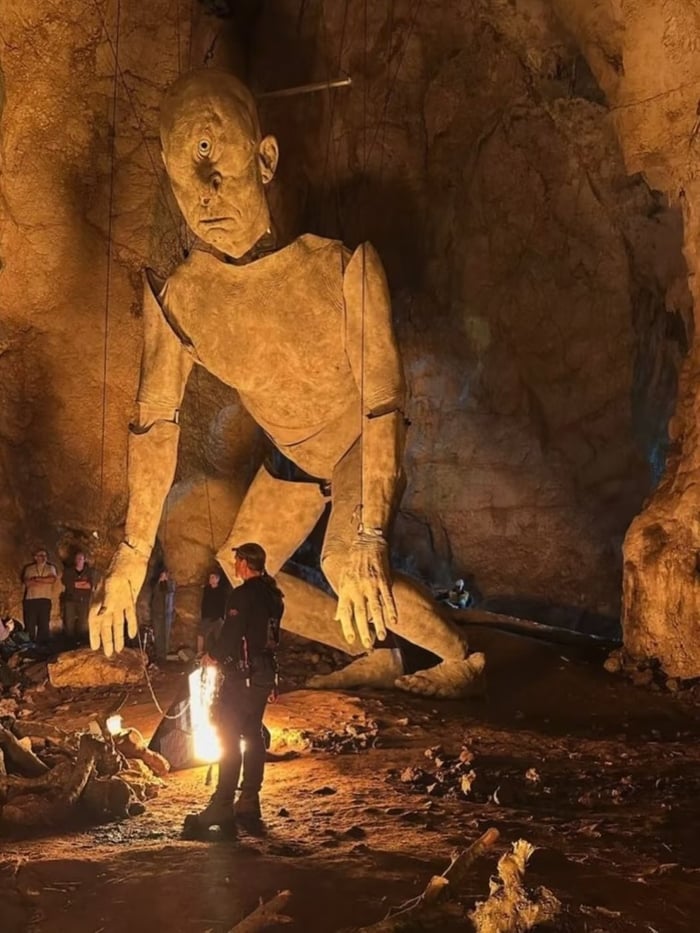
The most discussed scene is Polyphemus the Cyclops. Instead of building a digital creature, Nolan commissioned a 60 foot practical puppet operated on set by Bill Irwin, the same puppeteer who handled TARS in Interstellar. The creature's movements, voice, and physical presence were performed live. Forced perspective and camera placement sold the scale. That is the kind of choice the practical versus AI debate keeps coming back to, because you can feel the weight of something physically there.
The Pig Transformation Was Animatronics, Not Compositing
When Circe turns Odysseus's men into pigs, there is no digital compositing. Samantha Morton manipulated an animatronic head on camera, sculpting the transformation in real time. Anne Hathaway, watching on set, said the cast was there and still did not know how it happened. These are the moments that fuel the "Nolan does not use computers" reputation.
The "Zero CGI" Claim Is Mostly True, But Not Absolute
Here is the part that gets repeated less. Nolan's team minimized digital work, but they did not eliminate it. The sea monster Scylla was rendered with CGI, and the giant whirlpool sequence used digital compositing, as Hollywood Reporter's practical effects coverage noted. Industry coverage described those effects as moderate, which suggests Nolan reached for practical solutions wherever physically possible and kept digital tools for what could not be built on a soundstage. The honest framing is "practical first," not "CGI free." Anyone writing about The Odyssey vs AI should say that, because the absolute version is just not accurate.
Scene | How it was made | The honest takeaway |
Cyclops (Polyphemus) | 60 foot practical puppet, live operated | Pure practical, the headline claim holds |
Circe pig transformation | Animatronics on camera | Pure practical |
Scylla (sea monster) | CGI | Digital work was used here |
Whirlpool sequence | Digital compositing | Digital work was used here |
Nolan minimized CGI, he did not erase it. The practical-first method is the real story, and it is more interesting than the myth.
What Elon Musk's Grok Imagine Announced for an AI Odyssey
While Nolan's film dominated theaters, the AI side of the argument showed up loudly.
The Historically Accurate Claim That Historians Mocked
On July 22, 2026, Elon Musk announced that xAI's Grok Imagine would produce a full length "historically accurate" AI generated Odyssey film by the end of the year. Variety's reporting on the Grok Odyssey announcement covers the reaction. Historians immediately pointed out the irony of calling a mythological poem historically accurate. The announcement drew huge attention to a real question: could AI replicate a $250 million production for a fraction of the cost? The clip that shipped with the announcement was about three minutes long, showing Odysseus and Calypso.
Why a Three Minute Clip Is Not a Movie
The gap between a demo and a feature is the whole story. A three-minute AI-generated clip proves the model can render a recognisable scene. It does not prove it can sustain narrative, character consistency, and visual coherence across 135 minutes. That distinction matters for anyone evaluating what AI filmmaking tools can actually deliver today versus what they might deliver in two years.
Fountain O's Odysseus: The Fall and the $50K AI Film
Where Musk announced, someone else shipped.
A 135 Minute Feature Made Entirely With AI
Indie AI studio Fountain O released Odysseus: The Fall, a 135 minute fully AI generated feature. Hollywood Reporter's coverage of the AI feature details the production. The budget was roughly $50,000, spent mostly on cloud compute credits for Kling AI video generation. The script and narrative were written by humans. The visuals were generated entirely by AI. Founder Ash Koosha called it a proof of concept for democratizing epic storytelling. It streams on Fountain0.com for a $9.99 rental.
What the AI Film Got Right and Where It Broke
The film earned press for its ambition but mixed reviews. Critics noted visible artifacts in character animation and inconsistent visual quality between scenes. Most coverage treats it as a technical proof of concept rather than a finished artistic work. It showed a full AI feature is possible at a micro budget, but the quality gap with Nolan's production is still large. That gap is the actual terrain of the Odyssey vs AI conversation, not the hype around either end.
What The Odyssey vs AI Debate Means for 3D Creators
The debate usually gets framed as a binary: handmade authenticity versus machine efficiency. For a working creator, that framing misses the point. The real question is access. Nolan had $250 million, six countries, and a 60 foot puppet. Most creators have a laptop and a deadline. The interesting development is a third option sitting between those extremes.
The 3D Asset Bottleneck Nolan Never Faced
Whether you are building a game level, prototyping a product, or preparing a 3D print, the bottleneck is the same: producing 3D content takes time. Professional software like Blender or Maya takes hundreds of hours to learn. Outsourcing to a 3D artist runs hundreds of dollars per asset. For indie developers, solo creators, and small studios, those barriers have historically made 3D work expensive before the first model is even finished. Our guide on clean topology mesh best practices shows why clean geometry matters once you start, because the bottleneck is rarely the idea, it is the mesh.
How AI 3D Generation Closes the $250M Gap
AI 3D model generation changes the math. Instead of sculpting geometry vertex by vertex, a creator types a description or uploads a reference image and gets a usable mesh in minutes. The tool does not replace the artist's intent. It removes the mechanical overhead between an idea and a first asset. The parallel with the Odyssey vs AI split is direct: Nolan insisted on physical craft because he believes audiences feel the difference, but most creators are not competing with Nolan. They are trying to get a Cyclops on screen at all.
From Text Prompt to First Mesh in Minutes
The speed is the point. A base mesh that once took a modeler days now appears in the time it takes to write a sentence and wait for a render. For character work specifically, our guide to the best 3D character maker tools compares the current options side by side, because picking the right generator matters as much as the prompt you feed it.
Where AI 3D Generation Fits in the Practical vs AI Split
The practical versus AI argument is not a conflict for 3D creators. It is a spectrum of access. Nolan sits at one end with a studio budget. Fountain O sits at the other with an AI pipeline and a micro budget. AI 3D generation tools sit in the middle, giving solo creators a way to produce assets that would have required a trained modeler days or weeks ago.
Approach | Cost | Time | Output | Best for |
Nolan's practical effects | $250M (whole film) | Months of builds | On-camera physical props | Theatrical spectacle |
Fountain O's AI film | ~$50K (whole film) | Weeks of generation | Full AI video | Experimental features |
AI 3D generation tool (Triverse AI) | Free to low monthly | Minutes per asset | 3D model (GLB/OBJ/FBX) | Asset prototyping, indie pipelines |
The third row is where most working creators actually live. It is not competing with Nolan, and it is not a finished film like Fountain O's. It is the modeling stage, collapsed from days to minutes.
Generating Odyssey Series Models From Images / Prompts
Imagine typing "a one eyed Cyclops, textured, game ready" into a generator or just uploading a reference image and receiving a clean mesh with PBR materials in under two minutes.
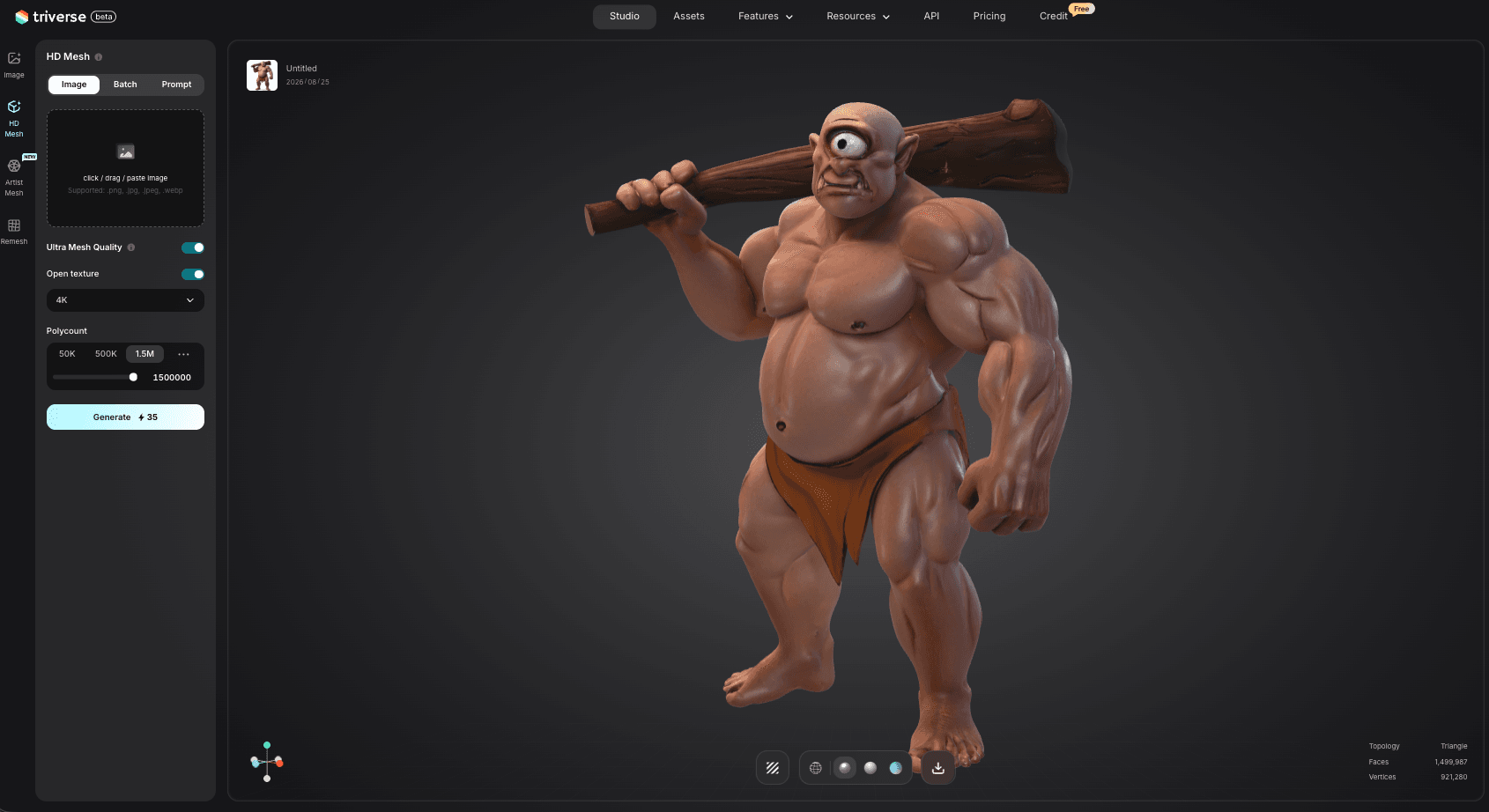
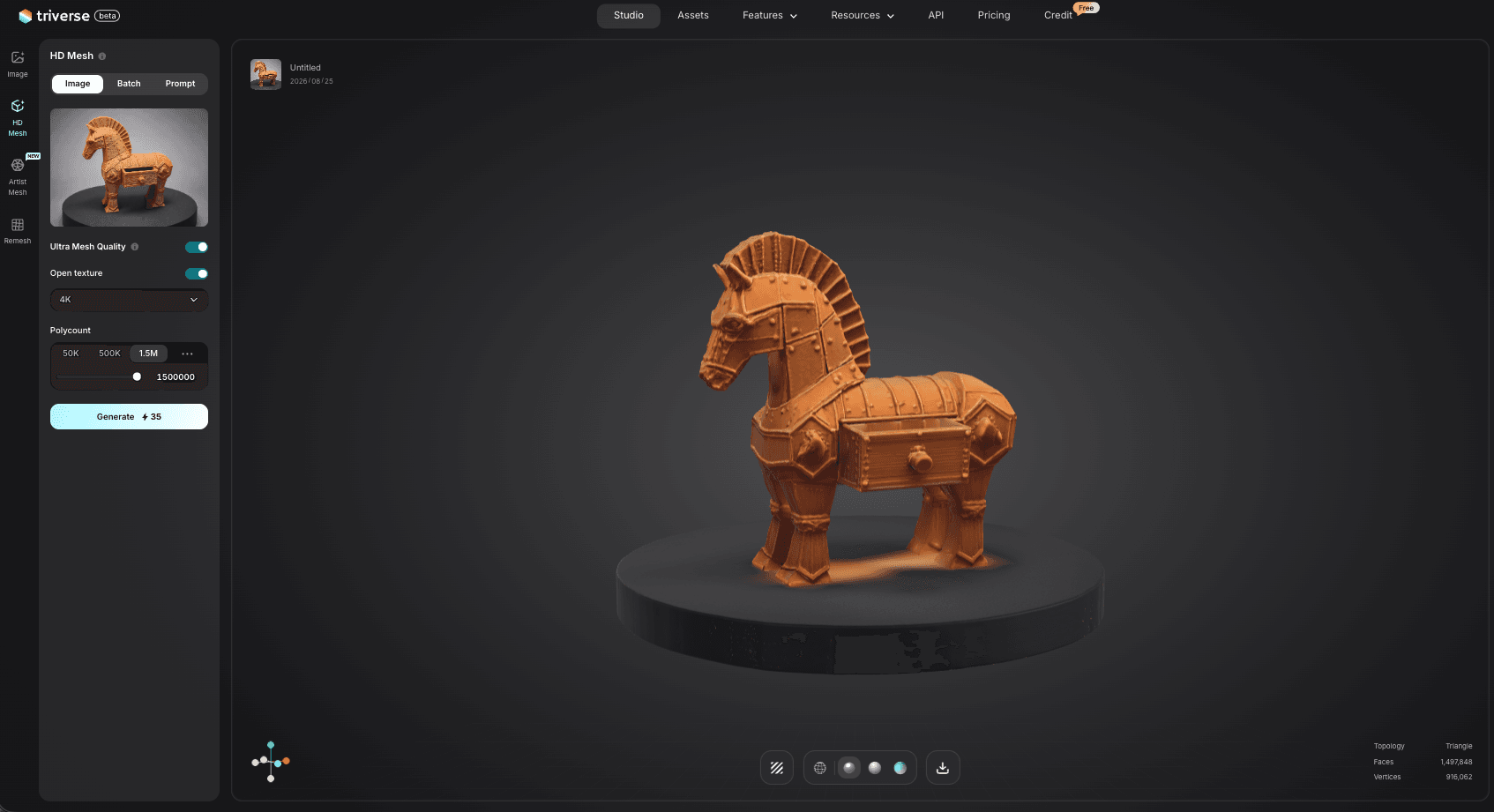
Tools like Triverse AI turn a text prompt or reference image into a 3D character you can export as GLB, OBJ, or FBX and drop into Blender. For character work specifically, our guide on creating 3D models from original characters walks through the image-to-3D workflow with reference sheets. The output is a base mesh, not a finished film asset, but it skips the longest part of the modeling process.
What AI 3D Tools Can and Cannot Do for Filmmakers
Be clear about the limit. AI 3D generation produces models, not movies. A generated Cyclops still needs rigging, animation, and compositing before it appears on screen. It is an asset stage tool, the same role a modeler fills on a traditional pipeline, not a replacement for the whole pipeline. For studios without large art teams, the value is speed and iteration: generate five concepts, pick one, refine it. Our breakdown of game ready 3D model requirements covers what "production ready" actually means once the base mesh exists. Our guide on PBR texture baking explains the material step that follows, because a raw generated mesh is rarely the last word on how a creature looks on camera.
Why Generated Models Still Need Rigging
The gap between a static mesh and a creature that moves is the rig. AI tools hand you geometry, not the bone structure and shape keys that drive animation. That is the part of the Odyssey vs AI story where human craft stays non negotiable, no matter how good the generator gets.
How to Use AI 3D Generation After The Odyssey
The takeaway from the Odyssey vs AI moment is not that practical effects won or AI won. It is that the cost of making something visual used to require choosing between a studio budget and giving up. That choice is shrinking. Nolan will keep building puppets because he can and because his audience responds to it. Independent creators now have a middle path: generate the base asset with an AI 3D model generator like Triverse AI, then apply the craft that makes it theirs.
If you want to test the workflow, start with a single character. Generate a model from a text prompt, export it, and open it in Blender to see what cleanup remains. You will learn more about asset production in one session than from a week of tutorials, because you are fixing a real model instead of following a lesson.
Bottom Line
The Odyssey vs AI story is really a story about access. Nolan proved audiences still show up for work made the hard way. Fountain O proved a full AI feature is technically possible at $50K. The space between them, where AI 3D generation lives, is where most creators will actually build. Use the tools for what they are good at: collapsing the distance between an idea and a first usable asset. Leave the 60-foot puppet to Nolan.
FAQs about The Odyssey vs AI:
Did Nolan use any AI or CGI in The Odyssey?
Minimally. The sea monster Scylla was rendered with CGI, and the whirlpool sequence used digital compositing. Most of the film's signature scenes, including the 60 foot Cyclops puppet and the Circe pig transformation, were practical. Nolan's approach is best described as practical first, not CGI free.
Can AI replace practical effects?
Not yet for theatrical quality. Fountain O's AI feature showed the format is possible but received mixed reviews for animation artifacts and inconsistent visuals. Practical effects still deliver a level of physical presence AI has not matched at scale.
Is Grok Imagine's AI Odyssey film out yet?
No. Musk announced it on July 22, 2026 with a roughly three minute AI generated clip, but the full length film was described as a year end target. As of the film's opening summer, only the teaser exists.
How much did Fountain O's AI film cost?
About $50,000, spent mostly on cloud compute credits for Kling AI video generation. The script was written by humans and the visuals were generated entirely by AI. It streams on Fountain0.com for a $9.99 rental.
What does The Odyssey vs AI mean for indie creators?
It shows the gap between studio budgets and solo creation is narrowing. AI 3D generation lets a solo creator produce assets that once required a trained modeler, though finishing work like rigging and animation still applies.
Can I generate 3D models like the Cyclops with AI?
Yes, as a base mesh. Text and image to 3D tools can generate a creature model you export into Blender, but you still need to rig, refine the textures, and animate it before it is screen ready.